

Seed Identification
Maple Tree Seeds: Identifying Samaras, Habitat & Photos
Identify maple tree seeds from photos with clear visual clues, seasonal context, and common lookalikes. Practical checks you can do before relying on one image.
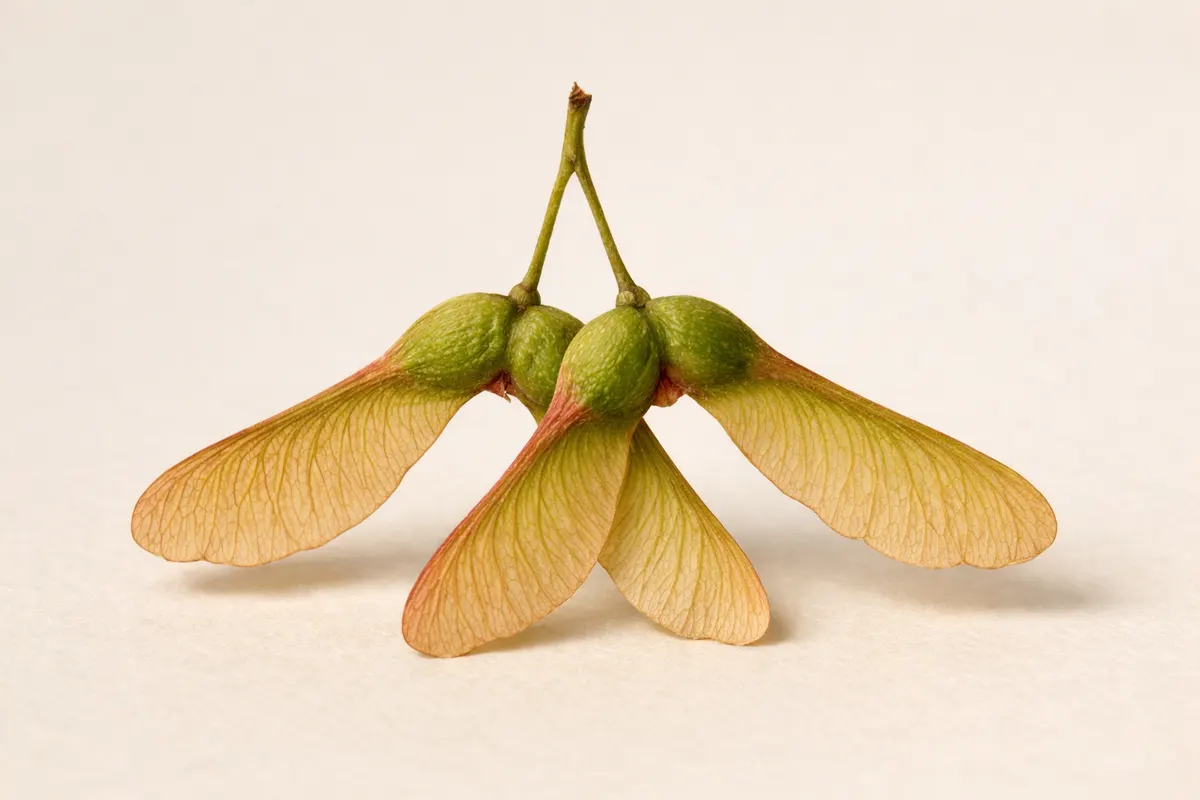
What maple tree seeds (samaras) are
Maple tree seeds are samaras: small dry fruits with a single seed attached to a papery wing that helps the seed spin as it falls. The wing-and-seed pair makes a distinctive ‘‘helicopter’’ or ‘‘whirligig’’ motion in the air; that flight behavior is often the first clue people notice.
Samaras are produced by trees in the genus Acer (maples). Size, color and exact wing shape vary across species — from compact 1–1.5 cm wings on smaller maples to 3+ cm wings on larger species — but the consistent pattern is a seed located at one end of an asymmetrical wing.
Photographs that include a samara plus a bit of branch, leaf arrangement, or the manner they’re clustered on a stem give the best evidence for identification. Single detached samaras have useful surface cues, but context strengthens any photo-based ID.
- Typical structure: one seed + one wing (sometimes appearing in paired cluster attached to a short stalk).
- Commonly seen on the ground beneath maples and in clusters on terminal stems before release.
- Key photographic clues: wing venation, curvature, seed position, and whether samaras occur in pairs.
How can you tell maple tree seeds in a photo?
Start with overall silhouette: maple samaras usually have a teardrop seed with an elongated wing; from the flat view the wing often appears as a narrow, curved blade. Look for a seed bulge at one end and a tapering wing that carries a visible central vein or parallel veins.
Measure relative size in the picture where possible: a rule of thumb is a wing length between 1 and 3 cm for many common temperate maples. Include a coin, ruler or a leaf for scale in future photos; without scale, species-level ID is rarely reliable from one image.
Check attachment and pairing. Many maple samaras develop in distinctive paired clusters (two wings spreading from a short stalk) — that paired arrangement is an important diagnostic signal. Single detached samaras are normal, but a paired stem visible in the photo favors an Acer origin.
Assess surface texture and color: young samaras may be green and translucent with visible veins; mature samaras often turn tan, brown, or reddish and dry to a papery texture. Damage, mold, or insect galleries change appearance and reduce confidence in a photo-only ID.
- Wing shape and vein pattern: straight central vein vs multiple parallel veins.
- Seed-to-wing ratio: seed size relative to wing length narrows species possibilities.
- Pairing and attachment: single vs paired samaras and the short stalk are telling.
- Context cues: opposite leaf scars, bark texture, or nearby maple leaves strengthen the ID.
Key facts
The table below condenses the most reliable physical attributes to check in a photo and what those attributes typically look like for maple tree seeds. Use this as a quick checklist when you inspect or photograph a samara.
These attributes help separate true maple samaras from other winged seeds and provide the baseline for photo comparison and field notes.
| Attribute | Typical range or example | Why it matters |
|---|---|---|
| Wing length | 1–3 cm (commonly) | Size varies by species and by whether the wing or whole fruit is measured; compare with a species reference rather than excluding maple by size alone. |
| Seed position | Seed at one end of the wing | Distinctive asymmetry of maples vs centrally-located seeds in some other trees |
| Pairing | Often occurs as paired samaras on a short stalk | Paired attachment is a strong Acer indicator |
| Color/texture | Green (fresh) → tan/brown (mature), papery when dry | Maturation stage affects vein visibility and surface reflectance |
| Vein pattern | One prominent vein or parallel veins along the wing | Vein layout is photo-visible and useful for comparison |
| Season | Late spring to autumn depending on species | Timing helps filter possibilities by local phenology |
| Typical habitat | Woodlands, urban parks, roadsides | Maps to where you’re likely to encounter samaras |
trees with helicopter seeds: where samaras appear
You’ll encounter maple tree seeds in parks, yards, forests and along streets where maples are planted or native. In many temperate zones maples release mature samaras from late spring through fall, with local timing varying by species and climate.
Samaras are frequently visible on and under the parent tree, collected in gutters and leaf litter, and sometimes temporarily suspended on fences or railings. Seeing samaras in flight or still attached to twigs provides the clearest evidence of their origin.
Because maples are widely planted, samaras turn up in urban and rural settings. When you find a candidate samara, record the surrounding habitat — planted avenue, mixed hardwood forest, riparian strip — it helps rule out lookalikes that favor different settings.
| Region / Habitat | When you'll see it | What you'll notice |
|---|---|---|
| Urban parks & streets | Spring to autumn, season depends on species | Detached and paired samaras, often under single trees or in gutter accumulations |
| Mixed hardwood forests | Late spring (flowering) and late summer–fall (mature seeds) | Sporadic drifts of samaras on the forest floor and in canopy gaps |
| Roadsides and hedgerows | Late summer–fall | Lines of samaras along curbs and ditches after wind events |
| Riparian corridors | Late spring to autumn | Dense patches beneath mature maples; seed dispersal aided by wind patterns |
| Plantings / ornamental rows | Seasonal drops often concentrated beneath planted trees | Consistent annual patterns tied to tree species and age |
- Look under tree canopies and along storm drains after dry wind; samaras accumulate in lines and whirlpools of leaf litter.
- Note whether samaras are found singly or in seasonal flushes — large simultaneous drops in autumn are common with some species.
- Collect photos showing the samara plus nearby leaves or bark for stronger identification.
Commonly confused with
Several other trees produce winged seeds or samara-like fruits that can be mistaken for maple samaras in photos. The most frequent confusions are with ash keys, elm samaras, and seeds from non-native species that also have winged dispersal.
Ash (Fraxinus) produces single-seeded samaras that are often longer and narrower and occur in clusters on a compound rachis rather than in the paired short-stalk arrangement typical of many maples. Elm (Ulmus) samaras are typically rounder and have a seed centered in a circular wing, not at one end.
When comparing photos, focus on the seed’s placement within the wing, the presence or absence of a paired stalk, and nearby diagnostic tree features such as leaf arrangement (maples have opposite leaves). These cues are often visible even in handheld photos and help rule out common lookalikes.
- Ash keys: longer narrow wings, typically on compound clusters; check rachis rather than a short paired stalk.
- Elm samaras: rounder wing with centered seed; not teardrop-shaped like most maples.
- Non-native winged seeds: compare vein pattern and seed position; many exotic species use different vein arrangements.
Care and handling of collected samaras
Separate a dried specimen kept for observation from seed intended for planting. For photography, set the samara on a neutral background without forcing or flattening it. Seed-storage requirements vary by maple species; do not dry every maple seed as a general rule. Silver maple seed, for example, needs moisture to retain viability.
Do not assume samaras are safe to ingest; many tree seeds are bitter or contain compounds unsuitable for food. If you plan to sow samaras, check local regulations and invasive-species lists before planting — some Acer species can be locally invasive and plantings may be restricted.
Handle samaras gently; the wings tear easily and small seeds can be lost. Label any collections with date, location, and tree context (leaf type, bark photo) to preserve photo-based evidence for later verification.
For species-specific storage guidance, see the USDA Forest Service account of silver maple: https://research.fs.usda.gov/silvics/silver-maple. Storage advice for one maple should not be generalized to every Acer species.
- Identify the maple species and consult its propagation guidance before drying or storing viable seed.
- Label with location and date for future comparison.
- Do not feed to pets or children without authoritative safety guidance.
Frequently asked questions
How should I approach maple samara identification from a single photo?
Treat a single photo as a first-pass hint: check wing shape, seed placement, vein pattern, and whether a paired stalk is visible. Add context with a scale object and a shot that includes nearby leaves or bark. If the photo lacks scale or context, note the uncertainty and gather additional images from different angles before concluding.
When do maple tree seeds usually fall in the northern hemisphere?
Timing varies by species and latitude, but many temperate maples shed mature samaras from late summer into autumn. Some species also produce samaras in late spring or early summer. Local climate and the tree’s health can shift these windows earlier or later by several weeks.
Are maple samaras safe for pets or children to touch?
Do not infer food or animal safety from a seed photograph. Keep unknown seeds away from children and pets. If ingestion is suspected, contact a poison-control service or veterinarian with the plant details and exposure information; do not assume that effects will be mild.
What's the best photo setup to capture samara details for reliable ID?
Use natural, diffuse light and include a size reference like a coin or ruler. Photograph the samara flat-on to show wing venation and from the side to show seed bulge and curvature. Capture any attached stem, nearby leaves, and a section of bark to provide context for stronger identification.
Related guides
Compare your seed photo with Seed Identifier - Seedio
After you check the visible clues above, try Seed Identifier - Seedio as a useful next step to compare your photo against the Maple Samara features listed here. Seedio provides a first-pass visual comparison to highlight matching signals; treat its result as one piece of evidence and combine it with the field clues and the photos you gathered. Learn more or run a comparison at https://seedidentification.app/ and consult the site’s photo-identification guidance for best practices.
Take the next step →