Trees With Helicopter Seeds
Trees With Helicopter Seeds: How to ID Common Samaras
Compare trees with helicopter seeds using samara shape, wing arrangement and leaf clues. Learn how maple, ash and elm fruits differ and what to photograph.
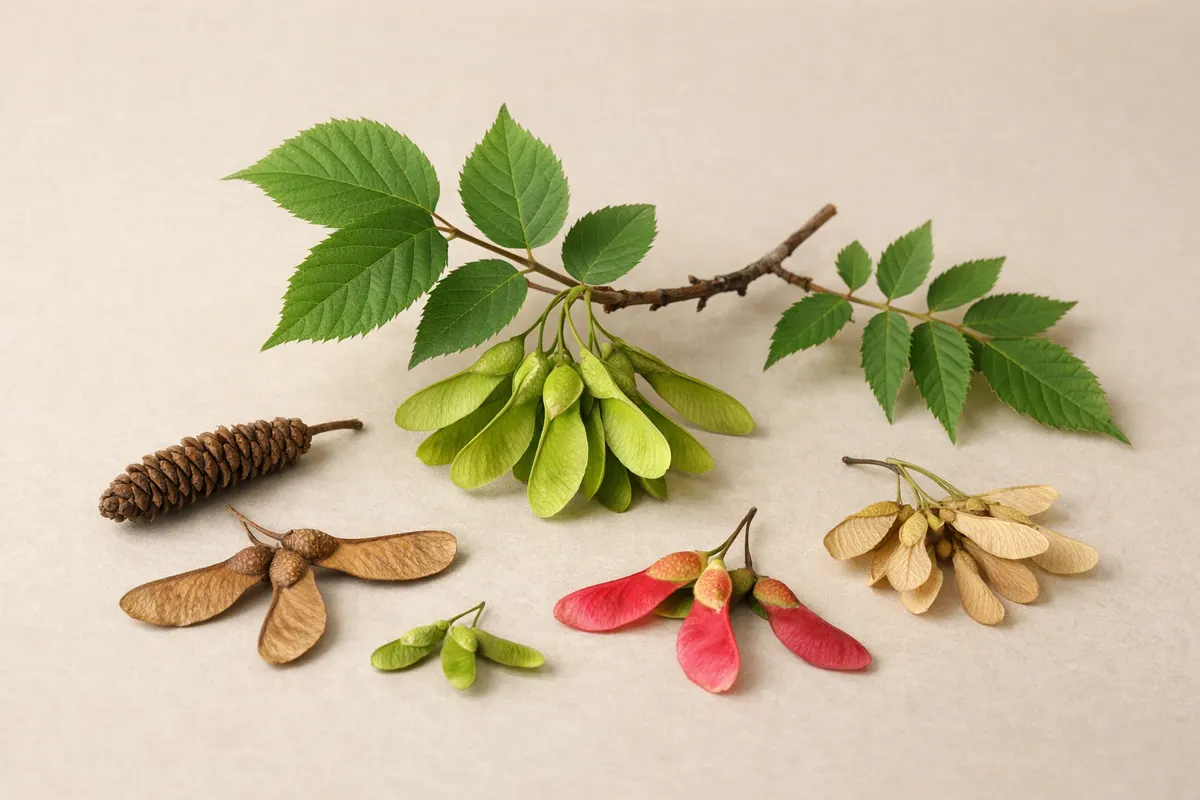
Trees with helicopter seeds are species that shed winged samaras that spin as they fall. A clear photo of the seed cluster, the attachment point on the twig, and nearby leaves gives a fast first-pass identification that narrows the possibilities from dozens of trees to a few familiar groups.
This page helps you spot the decisive visual clues — wing shape and size, seed placement, twig and leaf context — so you can collect the right photos for a useful first-pass comparison. That short checklist saves time and reduces misidentifications before you use a photo-based tool.
Use the visible outcome first: the goal is to name the likely tree type (for example paired maple samaras versus individual paddle-shaped ash samaras), explain the evidence in the image, and list sensible follow-up checks you can do in person.


How identification works
Step 1
Snap a photo
Take a clear, well-lit photo of your item in the Seed Identifier - Seedio app.
Step 2
Get an instant identification
The app reads the visible clues and returns the closest matches in seconds.
Step 3
Review the details
Check the attributes, rarity, and estimated value range before deciding your next step.
Key visual signals specific to helicopter seeds
Helicopter seeds (samaras) vary predictably by four visual signals: wing length and curvature, whether seeds are single or paired, where the seed attaches on the twig, and the surrounding leaf shape or bud type. Photograph each signal against a plain background and include a coin or ruler if possible to show scale.
Check the seed-bearing part as well as the wing. In maple fruits, each seed lies at the thick end of an elongated wing, and two fruits usually develop together as a pair. In elm fruits, the wing surrounds a more central seed. Color changes with maturity and drying, so use it as supporting context rather than a species test.
Compare these quick checks before a photo ID: wing length in millimeters, single versus paired arrangement, seed-to-wing proportion, and whether the samaras hang singly or in clusters from persistent fruiting stalks.
- Look for intact pairs: paired samaras suggest maple, but detached halves can appear single.
- Measure the whole fruit and record the units; sizes overlap between species.
- Record whether the seed lies at one end of an elongated wing or within a surrounding oval wing.
- Photograph leaves and buds on the same branch; loose leaves nearby may belong to another tree.
- Compare several undamaged fruits, since broken wings can obscure the original shape.
How to use a photo identification result
Treat a photo result as a candidate tree group to check, not proof of a species. Compare the proposed name with the fruit you actually photographed. If the image lacks an intact wing or the parent branch, note that missing evidence instead of assuming the tool supplied it.
Start with one clear close-up against a plain background, then retain separate photographs of leaves, twigs and the tree for your own reference. A measurement beside the fruit helps document scale, but a photo tool may not reliably interpret a ruler or distinguish every close relative.
Use a regional tree guide to check the candidate’s range and fruiting season. Do not assume that an app result automatically incorporates your location, flags invasive status or provides a calibrated confidence score. Local extension staff can help with ambiguous trees, especially before planting, removing or reporting one.
- Record the candidate name and which visible traits support it.
- Keep alternatives when wing or leaf details are missing.
- Check the tree’s location and seasonal context independently.
- Keep fallen fruits separate from assumptions about the nearest tree.
Common lookalikes — elm tree seeds and other confusions
Maples, ashes and elms all produce samaras, although the shapes differ. The familiar paired maple fruits have a seed-bearing thick end on each wing. Ash fruits are individual elongated, paddle-like samaras carried in clusters; they do not have the characteristic joined maple pair. See the White Ash fruit photographs at https://plants.ces.ncsu.edu/plants/fraxinus-americana/.
Elm fruits are samaras too. Their broad, oval or rounded wing surrounds the seed, rather than extending as one long paddle. Size varies by species, so avoid a universal millimeter cutoff. The American Elm guide includes documented fruit images: https://plants.ces.ncsu.edu/plants/ulmus-americana/.
Boxelder is a maple, Acer negundo, despite its ash-like compound leaves. It produces paired samaras grouped in clusters. Use the leaf and fruit together when comparing it with ash; the scientific name avoids confusion from common names. See https://plants.ces.ncsu.edu/plants/acer-negundo/.
“Sycamore” also needs a regional qualifier. North American sycamore, Platanus occidentalis, has rounded fruiting heads that break into many small fruits. Sycamore maple, Acer pseudoplatanus, is a different tree with paired winged samaras. Record the scientific name used by your regional reference before deciding which kind of fruit to expect.
- Maple: usually paired fruits, each with a seed at the thick end of a wing.
- Ash: individual paddle-like fruits grouped in clusters.
- Elm: a wing surrounding the seed; also a samara.
- Boxelder: a maple with compound leaves and paired fruits.
Frequently asked questions
How can I recognize ash tree seeds on the ground?
Look for individual narrow, paddle-like samaras, then compare them with fruit still on the tree if available. Ashes carry these fruits in clusters. An isolated maple half can look similar, so add leaf and twig evidence before choosing a genus.
Are elm tree seeds samaras?
Yes. Elm fruits are samaras with a wing surrounding the seed. Their rounded or oval outline differs from the elongated maple or ash wing. Dimensions and edge details vary among elms, so compare a measured fruit with a species reference.
Are sycamore seed balls the same as helicopter seeds?
North American sycamore produces ball-shaped fruiting heads rather than maple-style pairs. In parts of Europe, sycamore refers to sycamore maple, which does produce paired samaras. Check the scientific name and location to avoid mixing up these unrelated trees.
What photographs help identify maple tree seeds?
Photograph an intact pair, a single fruit with its thick seed-bearing end, and leaves or buds on the same branch. Include a ruler without covering the fruit. Those views support a maple comparison, but closely related species may still need additional evidence.
Related guides
Try Seed Identifier - Seedio after checking the visible clues
After recording the fruit and tree clues, use Seed Identifier at https://seedidentification.app/tools/seed-pod-identifier for a photo-based first pass. Compare the suggested identity with a regional tree reference and retain uncertainty when the required features are missing.