

Tree Seed Pod Identification by Photo: Pods, Samaras, Nuts, and Cones
Identify tree seeds, pods, samaras, nuts, and cones from photo-visible clues with practical comparison steps, limits, and safe verification guidance.
Quick answer for tree seed pod identification
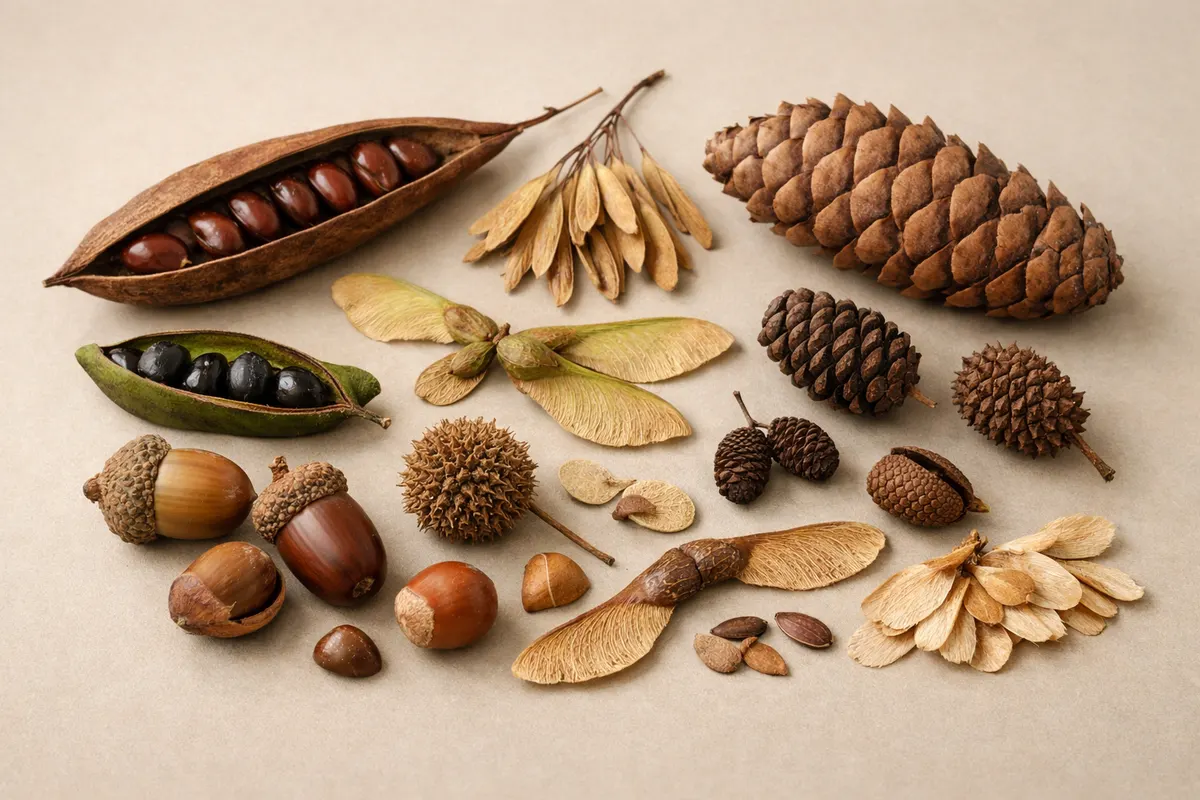
Tree seed pod identification starts with clear photos of the reproductive structure plus a few context shots. A single sharp image of a pod, samara, nut, or cone can often place the specimen into a group (e. g. , maples with paired samaras, legumes with elongated pods, conifers with cones), but it rarely proves a species on its own. For practical tree seed pod identification, combine visible traits — shape, attachment point, seed arrangement, surface texture, size with scale, and any nearby leaf or bark — to increase confidence.
What a photo can reveal: external morphology (winged vs. fleshy vs. woody), symmetry (bilateral, spiral, or compound), whether seeds are enclosed or exposed, and distinctive surface details such as hairs, ribs, or valves. What a photo cannot prove alone: exact species in groups with similar pods (several oaks produce similar acorns and cups), seed viability, edibility, or chemical properties. Season and location are additional clues that often tip the balance toward a correct identification.
If you only have one image, capture the most diagnostic view you can: a clear image of the attachment point where the pod meets the stem and a shot with something for scale (a coin, ruler, or fingertip). When practical, include a leaf and a bit of bark in the frame. These added context photos dramatically improve match accuracy for tree seed pod identification.
- Start by naming the structure type: samara, pod, nut, cone, capsule, or fleshy fruit, then compare attachment and seed layout.
- Use nearby leaves, bark, twig arrangement, season, and location as supporting evidence before narrowing to a tree group.
Photo checklist
Before you scan or submit a photo for tree seed pod identification, use a short checklist. These steps are designed to capture the visual evidence the app or an expert needs to distinguish between similar-looking pods and seeds.
Work through the checklist in the field. Doing the five checks below takes only a minute and markedly improves the odds of a useful match.
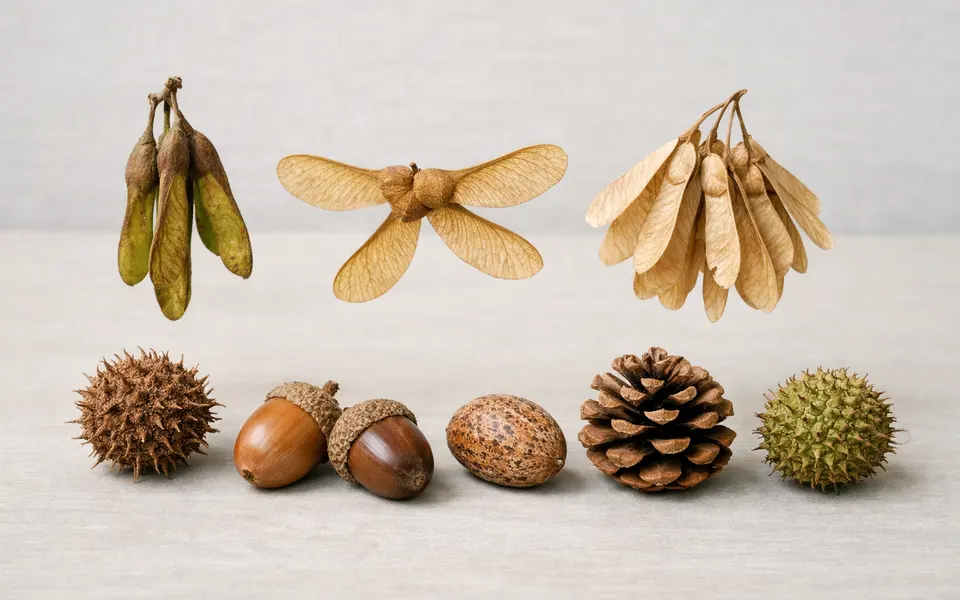
- Main view: One clear, in-focus photo of the entire pod/cone/samara on the plant (or laid flat if detached). Capture the whole object edge-to-edge, not cropped.
- Attachment: A close-up showing how the seed/pod attaches to the stem or branch (single point, cluster, or along a rachis).
- Scale: Place a common reference (finger, coin, or ruler) near the specimen so size is unambiguous.
- Detail shots: Close-ups of surface texture (hairy, smooth, ridged), seed interior if the pod is open, and the seed’s shape and color.
- Context: A leaf shot (both surfaces if small), a short segment of bark, and a wide shot that shows the tree’s silhouette or growth habit when possible.
Visual clues
Prioritize stable morphological clues over variable traits like exact color, which can change with age and light. For tree seed pod identification, the most reliable photo clues are: overall shape and symmetry, attachment arrangement, internal layout of seeds, and persistent surface features (ribs, hairs, valves, wings).
Use multiple clues together. For example, a winged samara plus opposite leaves strongly suggests a maple (Acer) rather than ash (Fraxinus) or elm (Ulmus), which have different wing shapes and leaf arrangements. Likewise, a pod that splits along two seams with many flat seeds points toward Fabaceae (legume family) members, while a hard, woody cone with spirally arranged scales points toward Pinaceae or Cupressaceae.
Below are the main visual categories to check in your photos and the specific clues to look for.
- Attachment point: Single-seeded nuts (acorns, hazelnuts) often have a cup or involucre; samaras attach at a winged base; pods may be attached by a short stalk or directly along a raceme.
- Seed arrangement: Singles (nut), pairs (many maples have paired samaras), rows (legume pods), or spirals (some cones).
- Surface texture: Smooth and glossy (some nuts), fibrous or hairy (certain pods), ridged or winged (samaras and winged seeds), or scaly/woody (cones).
- Dehiscence pattern: Does the pod split open along seams, or does it fall off intact? Photographs of an open pod showing seeds help confirm family-level ID.
- Size and scale: Exact size can eliminate many candidates—tiny samaras under 1 cm behave differently from 3–6 cm maple keys.
Examples by type
Grouping common tree reproductive structures by type helps you recognize patterns quickly. Below are practical photo-based examples with the most diagnostic views to capture for each type.
These examples emphasize the strongest, photo-visible differences rather than exhaustive species lists. Use them as a field guide for priority shots to take when you encounter an unknown seed, pod, or cone.
- Samaras (winged seeds): Typical of maples (paired, helicopter-shaped wings) and elms (single, asymmetrical wing). Best photos: entire samara pair, side profile to show wing thickness, and attachment point on twig.
- Legume-style pods: Long, often flat pods with multiple seeds inside (e. g. , honeylocust, black locust, and some peas). Best photos: whole pod, cross-section or opened pod to show seed arrangement, and the point of attachment.
- Nuts (one-seeded, hard): Acorns, hazelnuts, chestnuts. Best photos: nut with cup or involucre visible, underside of the cap, and nearby leaves because leaves narrow down oak vs. beech vs. chestnut.
- Cones (woody or fleshy): Conifer cones (pine, spruce, fir) or deciduous tree seed cones (e. g. , alder catkins that leave woody cones). Best photos: whole cone, scale close-up, and branch context (needle arrangement or leaves nearby).
- Samaroid/winged pods: Some trees have elongated winged pods (e. g. , some Dipterocarpaceae or certain ash species). Best photos: full pod on branch, cross-section if split, and adjacent foliage.
Compare likely matches
When a photo returns several similar candidates, separate them using a checklist of cross-check clues rather than relying on a single trait. Compare leaf arrangement (opposite vs. alternate), bark texture, seed/fruit timing (season), and nearby habitat. For example, paired samaras plus opposite leaves almost always point to maples rather than elms or ashes.
Here are practical comparison pairs and the decisive clues to prefer in your photos: maples vs. ashes, legumes vs. capsules, and acorns vs. beech nuts. Use the visual traits together in the order of most to least diagnostic.
If two candidates remain plausible after comparing visible clues, collect one additional piece of evidence: a clear leaf shot (both surfaces if possible), a picture of a mature tree habit, or a photo of the bud/young twig. That extra context often resolves ambiguity without needing microscopic or lab work.
- Maple (Acer) samaras vs. Elm (Ulmus) samaras: Check leaf arrangement (maples opposite, elms alternate) and wing symmetry (maple wings are equal and paired; elm wings are single and asymmetrical).
- Legume pods vs. dehiscent capsules (non-Fabaceae): Legumes usually split along two sutures and reveal flat seeds in a row; capsules may split irregularly and have different internal partitions—photo an opened pod to confirm.
- Acorns (oak) vs. beech/chestnut nuts: Acorns have a cupule (cap) with scales; beech nuts sit in a spiny bur; chestnuts have a green, spiky husk that splits into sections—capture the cap or husk detail.
- Pine cones vs. fir cones: Pine cones often fall off intact and have woody scales with visible bracts; fir cones typically sit upright on branches and disintegrate to release seeds—photograph cone position and attachment.
Common mistakes
Avoid these frequent errors when trying to identify tree seeds from photos. They lead to confident but incorrect IDs: relying on color alone, photographing only detached seeds with no scale or context, and assuming regional range without checking locality. Seed color changes with age and light, so texture and form are more reliable.
Another mistake is photographing only one view or only the detached seed. A nut removed from its cupule or a samara separated from the twig loses decisive clues about attachment and arrangement. If you find a detached specimen, still seek the attachment point on the tree or look for nearby pods on the ground with intact attachment parts.
People also jump to conclusions by matching a single photo to a popular search result without cross-checking leaf or seasonal data. Use at least two independent clues: seed structure + leaf shape, or seed structure + cone attachment. If those two clues conflict, collect more images before concluding.
- Mistake: Using color alone. Remedy: Focus on shape, ridges, and attachment.
- Mistake: No scale. Remedy: Include a coin or fingertip to show size.
- Mistake: Photographing only detached seeds. Remedy: Photograph attachment points and surrounding branch for context.
- Mistake: Assuming edibility or toxicity from appearance. Remedy: Never consume seeds or pods without authoritative verification.
App workflow
Use Seedio as a structured second step after you photograph the specimen. The best workflow for tree seed pod identification is: 1) Capture the checklist photos in the field, 2) Open the Seedio app and scan the best images, 3) Review the app’s suggested matches and the supporting visual clues it lists, and 4) If needed, add more photos from your gallery to refine the match.
Seedio works best when you feed it multiple targeted photos rather than one cropped image. Start with the full object photo to establish group-level ID (samara, pod, nut, cone); then submit close-ups of attachment and texture so the model can weigh those high-value clues. Use the app’s comment or note field to record location and date — seasonality is a powerful disambiguator for many species.
Remember the app is a first-pass tool: it will typically provide likely matches and confidence scores. Use those suggestions to focus additional field checks (e. g. , look for opposite leaves, count leaflet numbers, or photograph a full tree silhouette). If the app indicates low confidence or multiple similar matches, collect the extra contextual photos recommended above.
- Scan the strongest full-object image first, then add close-ups of attachment, texture, seed layout, and nearby leaves for refinement.
- Use the app result as a candidate list and collect one more context photo when the match depends on leaf arrangement or tree habit.
Next steps by confidence level
High confidence: If your photos and the app or guide point to a single species and multiple clues line up (seed type, leaf arrangement, habitat, and season), you can treat the ID as reliable for general purposes like gardening notes or casual natural history records. Still avoid making any claims about edibility, toxicity, or commercial value based solely on images.
Partial confidence: If identification narrows to a small group (e. g. , genus level) but species remains ambiguous, collect one or two targeted photos: detailed leaf venation, the underside of leaves, or the bud/flower if present. These images often provide species-level characters that seed photos alone cannot show.
Low confidence or conflicting evidence: When photos yield divergent clues or low-confidence app matches, verify with a local expert (native plant society, university extension service, or a certified arborist) before taking action that depends on accurate species identification (e. g. , planting decisions, wildlife food claims, or hazard assessments).
- Separate high-confidence, partial, and uncertain outcomes.
- Tell the reader when to verify with a trusted source or professional.
Limitations
Photos are powerful but limited. Tree seed pod identification by photo can usually determine the reproductive structure type and often the genus, but a single image seldom proves species in complex genera (oaks, willows, and some legumes). Closely related species can have nearly identical pods, differing only in subtle measurements, microscopic hair patterns, or internal seed anatomy.
Do not infer edibility, toxicity, or allergen risk solely from a photo. Many poisonous seeds look similar to safe ones, and toxicity often requires chemical analysis or tested ethnobotanical knowledge. For any use that affects health, livestock, pets, or commercial value, seek a verified source or laboratory confirmation.
Geographic and seasonal context matter. A seed type that’s common in one region may be rare or absent in another. When in doubt, provide location (general area, not exact GPS unless you are comfortable) and the date with your photos so experts or the app can weigh distribution and phenology.
- Separate high-confidence, partial, and uncertain outcomes.
- Tell the reader when to verify with a trusted source or professional.
Related guides
Try Seedio after photographing pods, samaras, nuts, and cones
After you photograph the seed or pod and capture supporting context (attachment point, leaf, bark, and a scale reference), open the Seedio app to scan your images. Use the app as a first-pass identifier: review suggested matches and then collect one more targeted photo if confidence is low. Seedio helps narrow likely IDs quickly, but always confirm important uses (edibility, removal decisions, or legal/value claims) with a trusted expert.
Take the next step →Frequently asked questions
Can I identify any tree species from a single photo of its seed?
Not reliably. A single seed photo can often place the specimen into a broad group (e. g. , samara vs. legume vs. nut vs. cone) and sometimes narrow to genus, but species-level identification usually needs supporting evidence like leaf shape, arrangement, twig buds, bark, or flowering/fruiting timing. Use additional context photos to increase confidence.
What photos should I take if I only have one chance to photograph a seed pod?
Prioritize a clear, in-focus shot of the whole pod on the plant with something for scale, plus one close-up of the attachment point. If possible, also quickly capture a leaf from the same branch and a short view of the bark or tree silhouette. These few images together provide far more diagnostic value than one isolated close-up.
Can Seedio tell me whether a seed is edible or poisonous from a photo?
No. Neither Seedio nor any photo-based tool should be used to determine edibility or toxicity. Visual identification can suggest likely species, but chemical composition and safety require authoritative references or lab testing. Always verify with trusted sources before consuming or feeding seeds to animals.
Why does the app sometimes return several similar matches?
Many genera produce similar seed pods or cones that differ only in small measurements or microscopic features. When visible clues overlap, the model lists several plausible matches instead of a single answer. Providing photos of leaves, buds, or the attachment point usually resolves those close matches.