

Seed Visual Checklist: Common Clues, Lookalikes, and Next Steps
Practical seed visual clues to help identify unknown seeds, with a clear checklist, common lookalikes, and safe verification steps for uncertain matches.
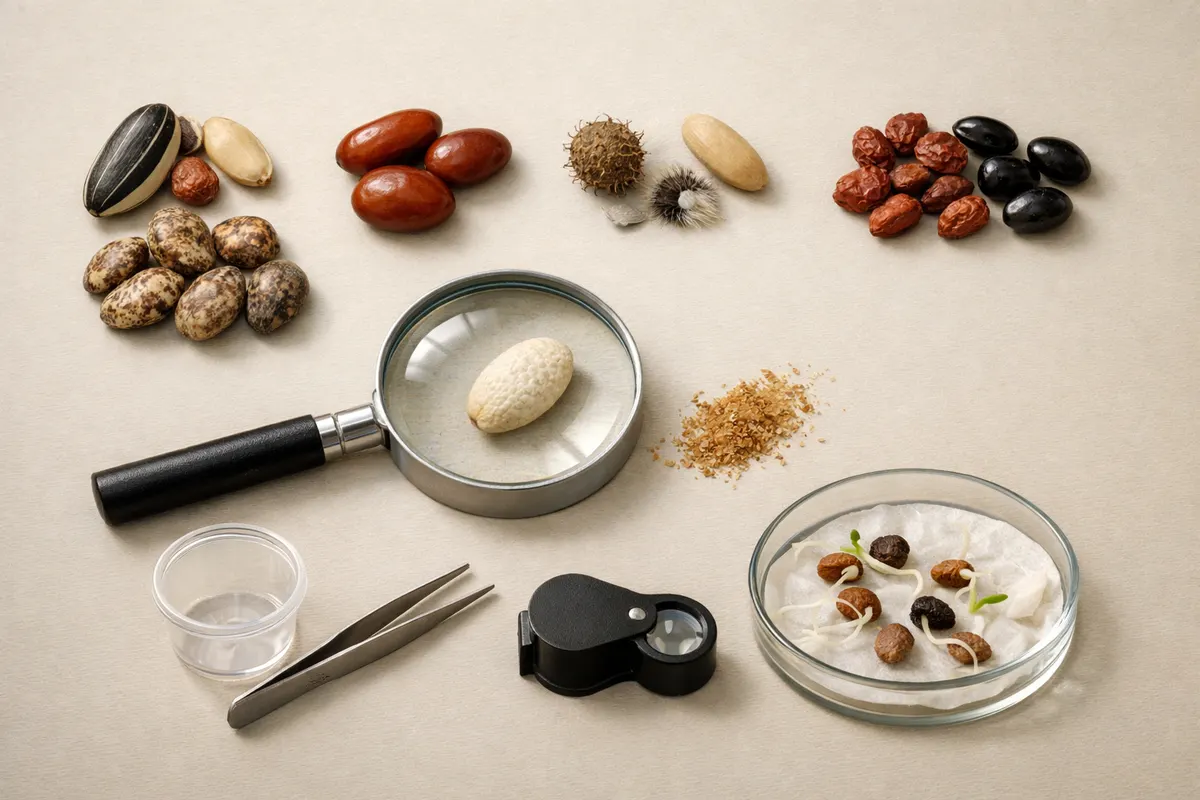
Quick answer for seed visual clues
If you found an unknown object and want a fast read: examine size, shape, and any attachments first. Seed visual clues such as a winged edge, a hairy tuft, a curved samara shape, or a smooth glossy coat narrow the field quickly and tell you which plant families to consider.
A single high-quality photo can suggest likely families (for example, samaras point to maples and ashes; winged or flat seeds often belong to trees; small round black seeds can be poppies or sedges), but it rarely proves a definitive species without context like the plant’s leaves, pods, or where you found it.
Use the visible clues to sort candidates into high-confidence or uncertain groups, document what you saw (photos from multiple angles, a ruler for scale, and notes about the plant or location), then follow verification steps such as cross-checking with regional guides or submitting images to specialists.
In short: seed visual clues help you build a short list quickly, but treat matches as working hypotheses until you confirm them with plant context, additional photos, or expert input.
- Start with size, shape, and unique attachments (wings, tufts, hairs).
- Add context: where it was found, the season, and nearby plants.
- Document carefully: clear photos, scale, and multiple angles before concluding.
Seed identification guide: what visual clues mean
A seed identification guide translates visible features into botanical signals: shape often reflects dispersal strategy (flat or winged for wind, hooks for animal attachment, fleshy arils for bird dispersal). Observing how a seed is built gives you immediate hints about its family and ecological role.
Color and surface texture tell different stories. Glossy, hard-coated seeds are often adapted to survive digestion or long dormancy. Tiny, dust-like seeds usually come from plants like orchids, poppies, or grasses, while larger, asymmetric seeds may come from trees or shrubs with specialized samaras or wings.
Attachments and remnants — such as the funiculus, aril, or leftover pod pieces — are especially diagnostic. For example, a visible hilum (the seed scar) and a reticulate coat point toward legumes; a slender wing down one side is characteristic of many tree samaras.
In practice, this guide approach means you start by converting a handful of visual clues into a shortlist of likely plant groups, then eliminate unlikely matches using context and comparison images.
- Dispersal structures (wings, tufts) suggest wind or animal strategies.
- Surface and color indicate dormancy traits and seed age, not always species.
Key visual clues to check on any seed
When you inspect a seed, cover the basics in a consistent order so you don’t miss subtle identifiers: note length/width in millimeters, overall shape (round, ovoid, flattened, winged), surface texture (smooth, pitted, hairy), color patterns (mottled, striped, uniform), and anything attached (wing, tuft, pod fragment).
Some clues are quick eliminators. A flat, papery wing almost always rules in a samara-bearing tree; a single hard, kidney-shaped seed with a seam suggests a legume; tiny angular brown seeds that cluster may be grasses or sedges. Recognizing these quick eliminators speeds identification.
Look for small but decisive marks: the hilum (seed scar) location and shape, a caruncle or aril (fleshy appendage), or an obvious embryo outline under a translucent seed coat. These micro-features often separate closely similar species.
Also evaluate environmental context visually: seeds found inside a dry pod or attached to a dehisced flower head (seed head) tell a different story from those scattered on the ground or inside fruit. The surrounding plant parts are often more diagnostic than the seed alone.
- Size and scale: include a ruler or coin in photos for accurate comparison.
- Shape: spherical, ovoid, flattened, winged, or samara-like.
- Surface: smooth, ridged, pitted, hairy, or resinous.
- Color: uniform, mottled, striped, or metallic sheen.
- Attachments: wings, tufts, arils, pods, or leftover calyx.
- Seed scar (hilum): position and shape (round, linear, kidney-shaped).
- Context clues: attached pods, seed heads, leaves, or nearby plants.
A step-by-step workflow for checking seed visual clues
1) Photograph and measure. Take at least three photos: top, side, and a close-up of any attachment or markings. Include a ruler or coin for scale and note the date and location. Good documentation preserves the visual clues you’ll rely on for comparison.
2) Sort by obvious features. Group seeds into broad buckets: winged, tufted, smooth large seeds, tiny dust-like seeds, or legume-like. This rapid sort narrows your search to relevant field guides or comparison images and reduces time spent on unlikely matches.
3) Compare to regional references. Use local field guides or reputable online collections to compare your bucketed candidates. Pay attention to life-form cues: is the seed from a tree, shrub, herb, grass, or aquatic plant? Regional floras eliminate species that don’t occur in your area.
4) Check plant context. If you can, collect or photograph leaves, pods, flowers, or the parent plant. Many seeds are diagnostic only when paired with pods or seed heads, and that extra context often confirms a species-level match.
5) Classify confidence and plan next steps. Mark findings as high-confidence (distinctive features match a single species or narrow group), tentative (several close candidates), or uncertain (multiple lookalikes or missing context). For tentative or uncertain results, gather more photos or consult local experts.
- Document: three photos (top, side, detail) + scale + location + date.
- Sort: group by dispersal feature (wing, tuft, pod, dust-like).
- Compare: regional guide or curated photo collections first.
- Context: leaves, pods, or nearby plants often clinch identification.
- Verify: specialists, extension services, or herbarium scans for uncertain matches.
Examples: common seeds and what to look for
Maple samaras: Look for paired or single winged seeds with a flattened blade and a small nutlet on one end. The length of the wing relative to the nutlet, and whether wings are paired or single, helps distinguish maples from similar genera. For detailed maple examples, regional guides like Maple Seed Identification: Samaras, Wings, and Tree Clues show local variations.
Sunflower and aster family seeds: These often show in seed heads with disk and ray florets. Seeds can be elongated and striped (sunflower) or tiny and angular (some asters). If you find many seeds in a composite head, note whether they were loosely attached or tightly packed — that tells you about the seed’s position in the flower head.
Beans and legumes: Legume seeds are often kidney-shaped, with a smooth coat and a visible hilum. Pods that split along two seams leaving seeds in a line point strongly to a legume. For pod-focused identification, see Seed Pod Identification by Photo: How to Read Pods, Seeds, and Plant Clues.
Tiny dust-like seeds: Poppies, orchids, and many grasses produce extremely small seeds. Because micro-seeds are hard to identify visually, the flowering structure or seed head is usually necessary to narrow the species down.
Weedy grass seeds and crop seeds: Grass seeds are typically narrow, elongated, and often have an awn or bristle. Compare with local weed guides when you find many similar seeds scattered across soil or compost.
Nuts and large tree seeds: These are robust, often with a tough coat and a clear hilum. If you find a large seed with a cupule or cap, look for the parent tree nearby — many tree seeds don’t travel far and are best identified by matching them to local tree species. For visual examples of flower-related seeds, consult Flower Seed Identification Pictures: Seed Heads, Shapes, and Common Matches.
- Maple samaras: wing shape and paired arrangement are key.
- Sunflower seeds: striped, elongated seeds from composite heads.
- Legumes: kidney shape and linear pod remnants point to peas/beans.
- Tiny seeds: require seed head or flower for reliable ID.
Limits of a single photo and safe next steps
A single photo rarely proves a species. Lighting, angle, scale, and missing context (pods, leaves, or fruit) can mask critical characters. Even experienced identifiers treat single-image matches as provisional and prefer multiple confirming traits before declaring a final ID.
Safety and certainty: do not assume edibility, toxicity, or legal status from a photograph. Many edible-looking seeds have poisonous lookalikes, and seed age or storage conditions can change appearance. If a seed’s identity matters for safety, agriculture, or legal reasons, seek confirmation from a local extension office, botanist, or certified lab.
When you have an uncertain match, prioritize further evidence: collect the parent plant parts, observe habitat and seasonality, or check seed pods and seed heads. For ambiguous or high-stakes cases, request an expert opinion and provide high-resolution images from multiple angles plus field notes.
Finally, accept three outcome levels and act accordingly: high-confidence matches can guide non-critical uses, tentative identifications are useful as research notes, and uncertain results should remain documented observations until verified.
- High-confidence: distinctive morphology + matching plant parts = okay for non-critical uses.
- Tentative: close match to several species — treat as a research note and gather more evidence.
- Uncertain: insufficient clues or many lookalikes — verify with an expert before acting.
- Verification options: local extension service, herbarium image comparison, or plant ID forums with provenance and scale.
Related guides
Use Seed Identifier - Seedio as a first pass after you check visual clues
After you document seed visual clues and sort likely matches, try Seed Identifier - Seedio for a first-pass comparison to curated photos and regional matches. Treat app suggestions as research notes: follow up by collecting context (pods, leaves, scale) and confirming uncertain matches with local extension services or herbariums before taking safety- or management-level actions.
Take the next step →Frequently asked questions
How can I use a single photo to narrow seed possibilities when I only have the seed and no plant?
Start by photographing the seed from multiple angles with a scale and neutral background. Note size, shape, surface texture, color patterns, and any attachments like wings or tufts. Sort candidates into broad groups (winged, tufted, legume-like, tiny dust-like) and consult regional photo references to eliminate impossible species. Treat the result as a tentative identification and seek additional context when possible.
What local sources should I contact to verify a seed identification when I'm uncertain?
Contact your county extension office, a local university herbarium, or a regional native plant society. Many extension services accept detailed photos and field notes and can either confirm an ID or point you to a specialist. Provide multiple high-resolution images, a size reference, and notes about where and when the seed was found.
Which seed lookalikes should I watch for when sorting backyard seed collections?
Common backyard lookalikes include poppy seeds versus small sedge or grass seeds; legume seeds versus hard-coated decorative beads; and tiny orchid or moss spores versus dust-like weed seeds. Also beware of decorative or craft beads that mimic smooth, glossy seeds. When in doubt, compare attachment points and any remaining pod or seed head — those features often reveal whether a seed is botanical or artificial.
When is it okay to act on a tentative seed identification for planting or feeding wildlife?
Act on a tentative identification only when the risk is low and you have corroborating context (e.g., the seed came from a clearly identified plant in your yard). For planting, verify that the species is appropriate for your zone and not invasive. For wildlife feeding, avoid offering seeds unless you’re confident they are safe and appropriate; when in doubt, use commercially recommended seed mixes or consult local wildlife experts.