

Maple Seed Identification: Samaras, Wings, and Tree Clues
A concise guide to maple seed identification: spot reliable samara and wing features, avoid common pitfalls, and follow safe photo-based checks.
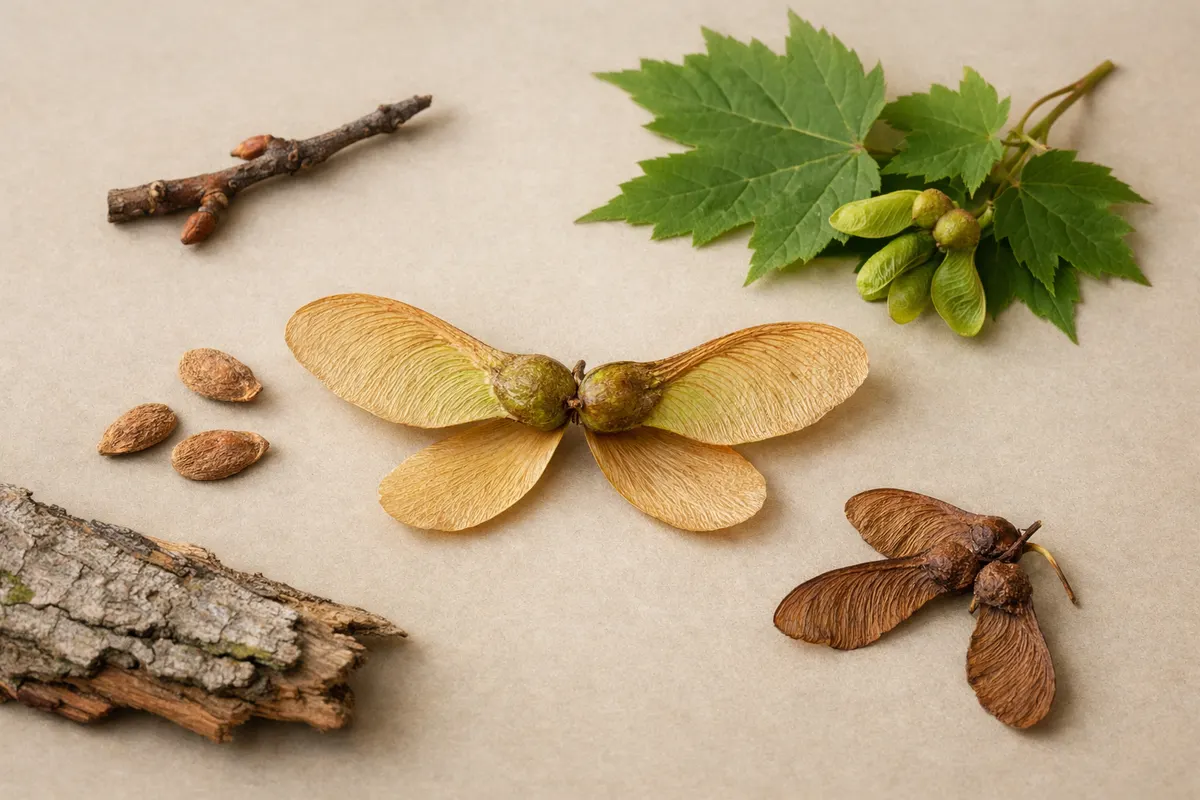
Quick answer: what photos can and can't prove about maple seeds
Maple seed identification starts best with the visible basics: look for a paired or single samara (the familiar winged
maple seed identification relies on several durable clues you can capture with a phone photo. A clear image of the samara shape, wing length and curvature, and the attachment point to the twin seed (if present) often separates maples from lookalikes. Those clues are much stronger than color or vague bark patterns.
No single photo proves species. A good photo narrows candidates to a short list—for example distinguishing Norway maple samaras (usually in tight pairs with broad wings) from boxelder or ash samaras—but confirming exact species usually needs additional evidence such as leaf shape, opposite vs alternate branching, or tree location and season.
If you want a quick field check: photograph the samara from both faces (top and edge), get a shot of the pair on the twig if present, and capture any nearby leaves or buds. These images give the strongest, realistic evidence for maple seed identification while keeping expectations grounded.
- Photos can reliably show samara type (paired vs. single), wing length, wing curvature, and whether the seed is centered or offset.
- Photos alone rarely prove species-level identity; use leaf, twig, and tree habit for confirmation.
- Good lighting and multiple angles turn a single image into a defensible ID shortlist rather than a definite label.
Strong visual clues for maple seed identification
When assessing maple seed identification from photos, prioritize clues that survive modest blur, shade, or slight perspective distortion. Shape and attachment are the most dependable: samaras that occur in pairs and join at a relatively straight suture are classic maples, while singly attached samaras or seeds in clusters suggest other genera.
Wing proportions and curvature carry a lot of taxonomic signal. For example, sugar maple (Acer saccharum) samaras tend to have relatively long, narrow wings with a more acute angle between paired wings, while silver maple (Acer saccharinum) often displays longer, more curved wings and a looser wing angle. Recording wing length roughly (short, medium, long) alongside curvature helps narrow possibilities.
Seed position inside the wing and surface texture are resilient clues. In many maples the seed sits near the wing base and the wing surface shows fine veins or a translucent membrane. Photographing the wing edge (to show thickness) and the join between seeds in a paired samara helps differentiate species and separates maples from lookalikes like ash or elm samaras.
Contextual tree clues strengthen the visual evidence. Leaves (opposite arrangement and lobed shape), twig nodes (opposite buds), bark texture, and the time of year are all high-value context. If a leaf photographed near the samara shows opposite branching with simple lobed leaves, that strongly supports a maple interpretation and complements the samara-focused maple seed identification.
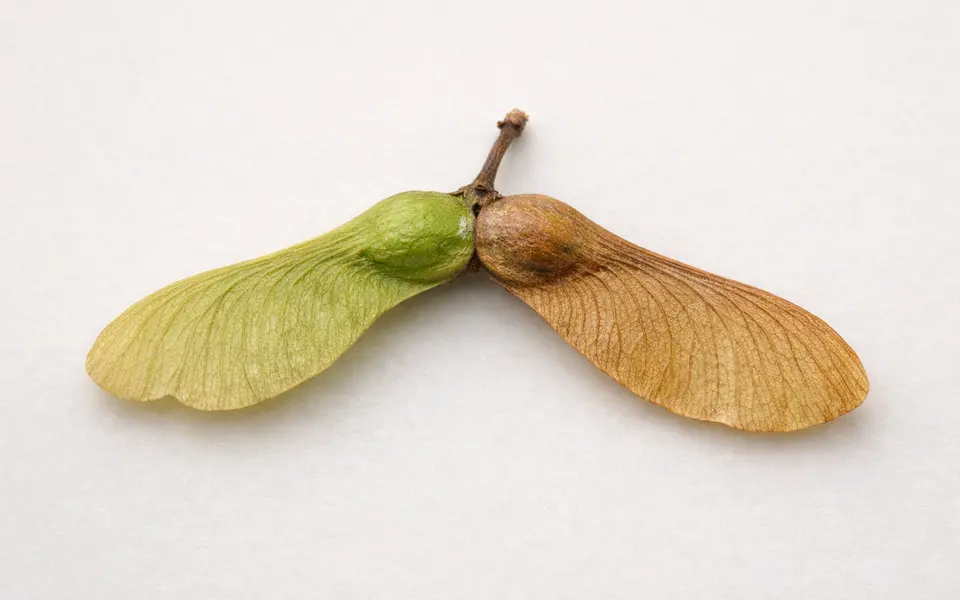
- Paired samaras joined at a common base — a hallmark of genus Acer and a primary maple seed identification clue.
- Wing length and curvature — note if wings are short and broad (some maples) or long and narrow (others).
- Seed position and wing vein pattern — visible veins or translucent membranes are durable photo clues.
- Leaf context: opposite leaf arrangement and typical maple lobing dramatically raise ID confidence.
- Twig and bud arrangement — opposite buds at the same node almost always point to maples or closely related families.
Weak or misleading clues to avoid relying on
Not all attractive details in a photo are reliable for maple seed identification. Color is one of the weakest signals: drying, sun exposure, and local soil can alter hue quickly, so matching a seed’s color to a pictured example is risky. Likewise, shiny or translucent areas might be glare rather than biological sheen.
Single-angle photos often hide critical geometry. A samara photographed flat on its wing can look very different from one photographed edge-on; apparent wing length, curvature, and even the perceived number of seeds can shift. Always capture at least two angles to avoid misreading the wing profile.
Scale without reference is another common trap. A seed photographed on an undefined background may look large or small compared with expectations. Always include a coin, ruler, or familiar leaf as scale—this simple step converts a weak signal into a meaningful measurement for maple seed identification.
Finally, scattered seeds on the ground can mix species. A collection of fallen samaras may include multiple trees nearby, especially in urban or park settings. Relying on mixed-ground samples without tree-level context raises the chance of false matches.
- Color alone — unreliable due to drying, light, and local staining.
- Single-angle photos — can distort wing length and curvature.
- No scale reference — impossible to judge absolute size and compare species.
- Ground-mixed samples — seeds from different trees may be conflated.
How to compare likely matches using multiple clues
Use a stepwise comparison workflow to move from a broad 'maple vs not-maple' decision to a short species list. Start with the strongest binary checks: are the samaras paired and do nearby leaves show opposite branching? If yes to both, you have a high-probability maple candidate and can proceed to wing geometry and leaf shape.
Next, compare wing geometry across candidates. Photograph measurements or relative descriptions help: note wing length (short/medium/long), whether wings are nearly equal or markedly asymmetrical, and the angle between paired wings. Combine those notes with leaf lobing and margin details to prune unlikely species.
Contextual checks come in next: habitat and season narrow possibilities. A samara found in a wet riparian strip is more likely from silver maple or boxelder than sugar maple; urban planted trees may include non-native Norway maple. Use these ecological clues as tie-breakers, not as primary proof.
If two species remain plausible, gather confirmatory photos: a close-up of the leaf blade (including petiole and base), a twig node to show bud arrangement, and an overall tree habit shot. These paired samara plus leaf/twig photos typically provide enough evidence for confident field-level maple seed identification.
- Step 1 — Binary checks: paired samara? opposite leaves? If both true, treat as maple.
- Step 2 — Wing geometry: length, curvature, symmetry, and seed position inside the wing.
- Step 3 — Context: habitat, season, and tree habit to eliminate improbable species.
- Step 4 — Confirm with supportive photos: leaf close-up, twig node, and whole-tree habit.
Using an app after checking visual clues
After you collect the core photos and notes above, use Seed Identifier - Seedio as a next step to consolidate possibilities. Start by loading the best photos from your phone: a clear samara face shot, an edge shot showing wing thickness and curvature, and at least one leaf or twig image. Treat the app’s suggestions as hypotheses to evaluate, not final truth.
When you review the app’s candidate list, cross-check each suggested species against your visual checklist: do wing proportions and seed position match the candidate? Does the candidate’s leaf shape and opposite branching align with your photos? Prioritizing agreement across multiple clues reduces the risk of overconfidence from a single matching trait.
If the app returns uncertain or multiple close matches, note those results as research leads. You can use the app’s candidate names to search local floras or site-specific records, or to prepare comparison photos for a local naturalist or herbarium. Avoid claiming species-level certainty from a single app result—combine the digital suggestion with physical or expert confirmation when possible.
Remember site limits: do not upload or expect verification from this website unless you are using the Seed Identifier - Seedio mobile app per its instructions. The app is most helpful when paired with the photographic checklist you already created; use it to speed the comparison workflow and to record candidate names and confidence notes.
- Load multiple photos: samara face, samara edge, leaf/twig context.
- Treat app matches as hypotheses; confirm with at least two independent clues.
- Use candidate names from the app to check local field guides or regional records.
- Record uncertainty: mark low-confidence results as research leads, not facts.
Related guides
Try Seed Identifier - Seedio after your clue checklist
Once you’ve photographed samara face and edge views plus a leaf or twig, use Seed Identifier - Seedio on your phone to generate candidate matches and record your confidence level. Treat app suggestions as research leads—compare each candidate against your photos and local field guides, and mark uncertain results as notes for further verification.
Take the next step →Frequently asked questions
Can I identify maple seeds to species from one photo of a samara?
A single samara photo can often tell you it’s a maple (paired wings, seed position) and narrow down to a small set of species, but it rarely proves species-level identity. Leaf shape, bud arrangement, and tree habit are commonly needed to separate close relatives such as Norway, sugar, and silver maple. Treat a one-photo ID as a useful starting point and collect supporting images before concluding.
What is the most important feature to photograph for maple seed identification?
The most important image is a clear, well-lit face-on shot of the samara showing both wings and the seed join. That view reveals whether the samara is paired, wing symmetry, the angle between wings, and visible vein patterns. Follow that with an edge shot (to show wing thickness and curvature) and a photo of a nearby leaf or twig to capture context.
How much does seasonal variation affect maple seed appearance?
Seasonal variation influences color and condition but usually not core geometry. Fresh samaras photographed in spring and early summer look different from browned, dried samaras in fall, so color is an unreliable trait. Wing length, curvature, and seed placement remain stable across the season and are better for maple seed identification than hue or freshness.
What common lookalikes should I watch for when identifying maple samaras?
Common lookalikes include boxelder (Acer negundo) which is still a maple but with compound leaves and often different samara proportions; ash and elm produce winged seeds that can superficially resemble samaras but differ in attachment and vein pattern. Also, some legumes and other trees drop papery structures that can be mistaken for wings. Cross-check samara pairing, leaf arrangement (opposite vs alternate), and vein details to avoid misidentification.