

Seed Pod Identification by Photo: How to Read Pods, Seeds, and Plant Clues
Learn how to identify seed pods from a photo by checking pod shape, seed layout, texture, plant context, and when to use Seedio for a second look.
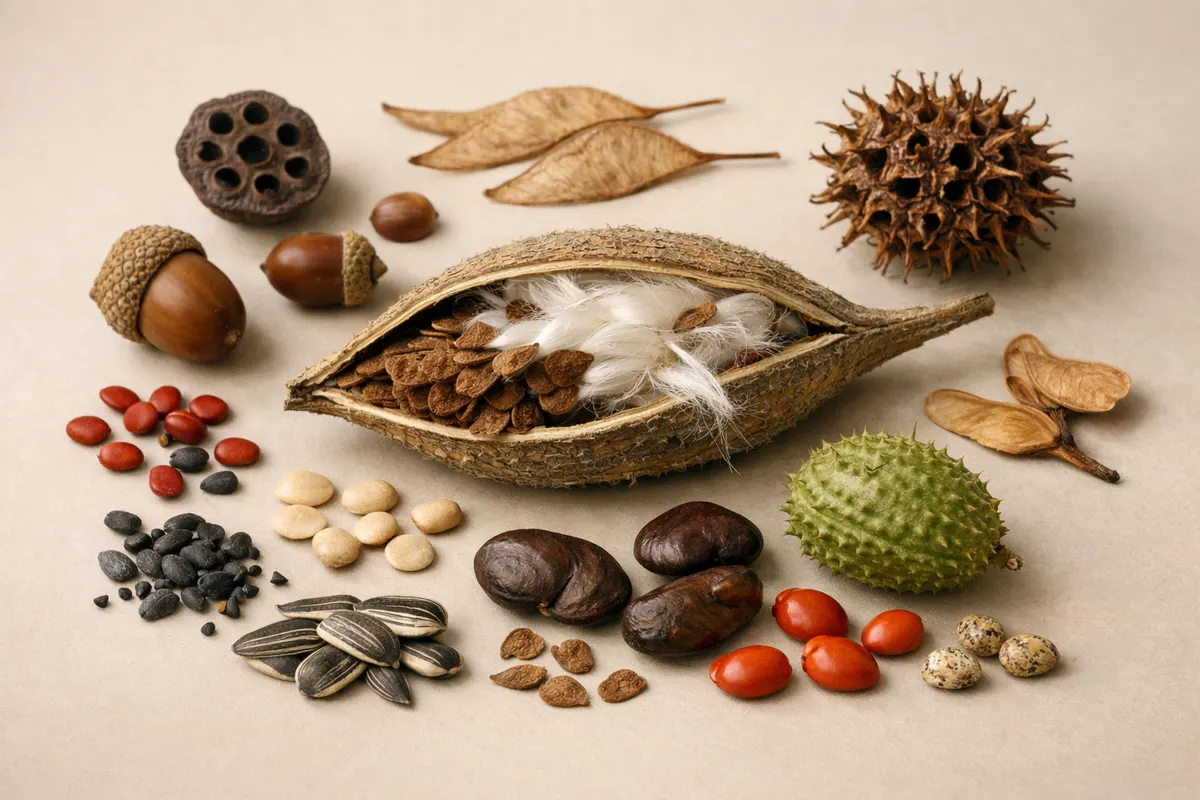
Quick answer for seed pod identification by photo
Seed pod identification by photo is possible when you capture a few repeatable visual clues: the pod’s overall shape, how it opens (if it does), the visible seed layout, surface texture, and any attached leaves or flowers. Those clues let you narrow the pod into a category (bean-like, capsule, samara, cone, fleshy fruit, etc.) and then match likely species by region and season.
A single photo of a loose seed or empty husk rarely gives a confident species ID. Instead, combine a full-frame photo of the pod, one or two close-ups of its opening or seeds, and a contextual shot showing leaves, stems, flowers, or bark. That combination raises accuracy dramatically for both human experts and AI tools.
Use the details you see—size, seam placement, chambered interiors, surface hairs, winged edges—and compare those to known pod groups before claiming a species. If you need help, apps like Seedio can use those images as a starting point, but local context (region, habitat, and season) and physical inspection are the final checks.
Photo checklist
Good photos are the single biggest factor in a successful identification. The checklist below is ordered by the images an app or a field guide finds most useful: start wide, then move in for details, and always include scale and context.
If you follow this checklist, you’ll capture the minimum set of clues that separate common pod types from each other and let AI or an expert eliminate unlikely matches quickly.
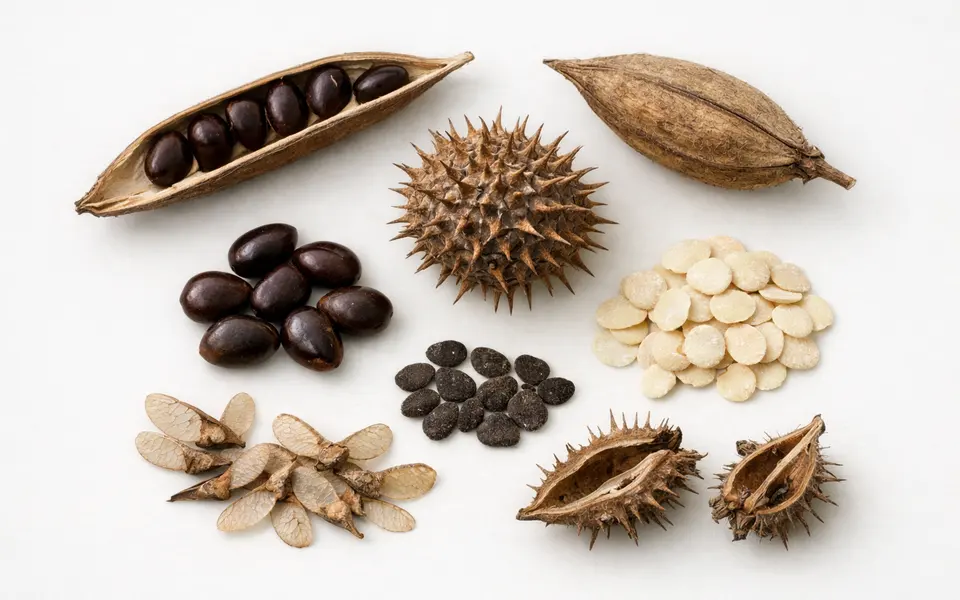
- Photograph the full pod before removing seeds.
- Add one close-up of the seeds, chambers, seams, or split edges.
- Include a ruler, coin, or fingertip for scale.
- Capture leaves, stems, flowers, bark, or the parent plant when available.
- Note where it was found: garden bed, tree, field, trail, or potting soil.
- Use natural light and avoid heavy zoom, blur, and harsh shadows.
Visual clues
Start by sorting the pod into a morphological category. Pod shape—long and cylindrical, flat, winged, capsule-like, cone-like, or berry-like—narrows the field immediately. For instance, long tubular pods with a visible seam often indicate legumes (peas, beans, lupins), whereas small chambered capsules are typical of poppies and many herbaceous plants.
Opening style matters almost as much as external appearance. Pods may split along a seam (legumes), break open at capsule pores, shed seeds through valves, or be eaten/softened like fleshy fruits. Photograph an open pod and the inside: look for chambers, partitions, or seeds attached to a central column.
Seed pattern and seed morphology give the next tier of clues. Are seeds in a single row, paired, or scattered loose? Do seeds have wings, hairs, arils, glossy coats, or ridges? Many tree samaras have thin papery wings; maple samaras are paired with a distinctive wing shape, while ash samaras are single and elongated.
Surface texture and colour help refine matches—smooth and glossy, papery and translucent, hairy, or woody. Texture combined with season (fresh green vs dry brown) can indicate whether you are looking at a recently matured pod or an old, weathered husk. Finally, plant context—leaves (shape, margin, venation), flowers (if present), bark texture, and overall growth habit—often supplies the decisive clue.
- Pod shape: long, round, flat, winged, cone-like, capsule-like, or berry-like.
- Opening style: split seam, chambered capsule, papery shell, woody cone, or fleshy fruit.
- Seed pattern: single row, paired seeds, many tiny seeds, wings, hairs, ridges, or glossy coats.
- Plant context: leaves, flower remains, stem texture, tree bark, and growth location.
- Maturity: fresh green, drying, fully brown, cracked open, or already dispersed.
Examples by type
Bean-like pods (Fabaceae family): These are usually elongated with a clear seam along one or both edges that splits to expose a single or double row of seeds. Look for a simple pulvinus (joint) at the base of the leaflets on the same plant, compound leaves (multiple leaflets on a single stalk), and occasionally twisting or spiraling pods when drying. Common garden examples are peas, broad beans, and lupins.
Capsules (Papaveraceae, Malvaceae, and others): Capsules are often shorter than legumes and open by pores, valves, or longitudinal slits. They frequently contain many tiny seeds packed into chambers. Poppy pods are classic capsule examples—you’ll see a rounded top with radial openings or a central disk where seeds escape.
Samaras and winged seeds (Acer, Fraxinus, Ulmus): These have a seed attached to a papery wing for wind dispersal. Maples (Acer) typically form paired twin samaras (helicopters) with a wide wing; ashes often have single elongated samaras. Pay attention to the wing’s angle and whether seeds are paired on a single stalk.
Woody cones and seed-bearing structures: Some trees produce hard, woody structures that look like pods but are actually cones or bracts (e.g., some magnolia or protea fruits). These often retain seeds in chambers and release them slowly. Match these to the tree’s bark, leaf type (needle vs broadleaf), and location—coniferous stands vs temperate broadleaf forests.
Tiny loose seeds (wind-dispersed dust or hairy plumes): When you see a cloud of tiny seeds with silky hairs (e.g., willowherb, milkweed, thistles), return to the parent plant and capture the seed head before it disperses. Scale is critical here: a single centimeter-scale close-up helps separate tiny dust-like seeds from larger grain-like seeds.
- Bean-like pods: look for length, seams, twist, and one-row seed layout.
- Capsules: look for chambers, pores, ridges, and many small seeds.
- Samaras: compare wing shape, seed position, and single vs paired form.
- Woody structures: pair the pod or cone with bark, leaves, needles, and location.
- Tiny loose seeds: add scale and trace where the seeds came from.
Compare likely matches
When an app or guide returns multiple close matches, don’t pick the top result immediately. Instead, compare the candidate species across the strongest clues. First, check pod category—if the top match is a samara but your pod splits like a legume, the top match is likely wrong. Pod category is the highest-weighted filter.
Next, compare opening style and seed layout. For instance, two lookalike pods might be the same color and size, but one splits on a single seam while the other opens with valves or pores—this separation will eliminate many false positives. If seed wings or hairs are visible, use those micro-features to differentiate species within the same family.
Use plant context as your tiebreaker. Leaves (simple vs compound, margin serration), flower remnants (petal color, shape), and habitat (wetland, roadside, urban garden) reduce ambiguity. If the top options disagree on more than one major clue, take the additional photos suggested by the app or the checklist and re-run identification.
- Compare the pod category before comparing species names.
- Check whether the opening style matches the likely result.
- Use leaves, flower remains, bark, and location to remove weak matches.
- Take more photos when the top options disagree on more than one clue.
Common mistakes
One frequent error is photographing only loose seeds or fragments and not the pod or parent plant. A heap of loose seeds tells you little about how those seeds were held or dispersed. Always capture the pod intact before you disturb it.
Another mistake is relying on color alone. Pods change color as they mature and dry: many green pods become brown and shriveled but still belong to the same species. Do not assume a brown pod equals a different plant. Also avoid heavy photo filters that mask natural texture and hue.
Ignoring scale and context reduces identification value significantly. Small seeds that look like pepper grains may actually be much larger if there is no scale reference. Similarly, assuming a plant is native or non-native without checking habitat or nearby plantings can lead you to the wrong species and unhelpful advice.
Finally, do not use a photo-based ID as the sole basis for eating, feeding to pets, planting, or removing vegetation in protected areas. Some seeds or pods can be toxic, invasive, or legally protected; confirm sensitive actions locally.
- Photographing only loose seeds without the pod or parent plant.
- Assuming dry pod color is the same as fresh plant color.
- Ignoring scale, location, season, and nearby leaves.
- Using a photo result for eating, pet safety, or planting decisions without confirmation.
App workflow
Use the app as a structured second opinion after you collect the photos from the checklist. Start by uploading a full-frame pod photo, then the close-ups showing seams, interior chambers, and any attached leaves or flowers. Tag the location and note the habitat type (garden, roadside, wetland). These fields are often used by plant ID models to prioritize regionally plausible matches.
When the app returns results, treat them as ranked hypotheses. Look at the top three matches and run the compare checklist: do they share the same pod category, opening style, and seed layout? If two top matches disagree on a major clue, add or retake the missing photo and resubmit.
Save all supporting photos and the date/location with the match. If you plan to act on the identification (planting, removal, or feeding), use the app to generate a short shortlist and then seek local confirmation—garden groups, extension services, or a field botanist are reliable next steps.
Next steps by confidence level
High confidence: If your photos, plant context, and app results all align on the same species—or species with similar care and safety profiles—save the match with date, location, and supporting photos. Label the specimen clearly in your records and, if relevant, note propagation or removal dates. High-confidence IDs are useful for personal plant records, citizen science posts, or garden planning.
Partial confidence: If the app narrows candidates but uncertainty remains between two or three species, photograph the missing clues that will separate them. For example, if the difference hinges on whether the pod is dehiscent (splits open) or indehiscent (remains closed), photograph the pod at different angles and after gentle handling—always avoid destroying rare or protected plants.
Low confidence: Keep a shortlist and research region and season. Some pods require seasonal context—flowers or foliage at a different time of year reveal distinctive features. When you cannot resolve the match, consult local sources (university extension, native plant societies, or a professional botanist) before taking actions that affect health, safety, or regulation.
- High confidence: save the match with date, location, and supporting photos.
- Partial confidence: photograph the missing clue that would separate close matches.
- Low confidence: keep a shortlist and compare region, season, and parent plant.
- Safety-sensitive use: confirm locally before planting, eating, removing, or sharing advice.
Limitations
Photos have intrinsic limits. Two different species can produce nearly identical-looking pods at certain stages, and lighting or angle can hide the decisive feature. For small seeds and internal structures, a basic phone macro may be insufficient—microscopic hairs, surface glands, or internal partitions often require a hand lens or stereo microscope to see reliably.
Geographic and seasonal context matter. Some plants are common only in specific regions or habitats; a model without regional priors may suggest improbable matches. Also, hybrid plants can show intermediate characteristics that confuse both human experts and AI.
Finally, never use a single photo ID as the only basis for actions with health, legal, or ecological consequences. If identification affects human or animal safety, regulated species control, or rare plant protection, seek in-person verification from a qualified local source.
Related guides
Scan the pod after collecting context
Use Seedio after you capture the intact pod, seed close-ups, scale, and parent-plant context. Compare the app shortlist against pod type, seed layout, region, and season before planting, eating, or removing anything.
Take the next step →Frequently asked questions
How accurate is seed pod identification by photo?
Photo-based identification can be very accurate at sorting pods into morphological categories (legume, capsule, samara, cone, fleshy fruit), and often accurate to genus. Species-level accuracy depends on photo quality, visible diagnostic features, regional context, and whether the plant is in a differentiating stage. For safety-sensitive or regulated decisions, confirm with a local expert.
What photos should I take to identify a seed pod?
Take a full-frame photo of the intact pod, at least one close-up showing seams/openings or seeds, and a context shot including leaves, flowers, or the whole plant. Include a scale object (ruler, coin, fingertip) and note location and habitat. Natural, diffuse light and a steady hand produce the best detail for both AI and human reviewers.
Can I identify edible seeds from a photo?
Do not rely solely on photos to decide edibility. Visual similarity between edible and toxic seeds is common. Use photo ID only as a preliminary step and confirm with multiple sources—field guides, extension agents, or laboratory testing—before consuming or feeding seeds to animals.
Why did the app give multiple different species as matches?
Multiple matches occur when visible clues match several species or when essential diagnostic features are not visible in the photos. Differences in pod maturity, lighting, or missing context (leaves, flowers, habitat) reduce the model’s confidence and widen the candidate list. Taking additional targeted photos usually narrows results.
How do I identify tiny fuzzy seeds that look like fluff?
For tiny or fluffy seeds (milkweed, willowherb, thistles), include a close-up with scale, a photo of the seed head attached to the plant before dispersal, and a wide shot of the plant’s habit and leaves. Many fluffy seeds are from plants that have distinctive seed-head structures or flower remnants that provide a reliable ID.
Can I use these photos to track invasive or protected species?
Photos are useful for preliminary monitoring of invasive or rare species, but do not take management action based solely on a single photo ID. For invasive species removal, regulatory compliance, or protection of rare plants, document multiple high-quality photos, record GPS location and date, and contact local conservation authorities or extension services for verification and guidance.