

Seed Identification
Sweet Gum Tree Balls: How to Identify, Where They Grow, and Lookalikes
Identify sweet gum tree balls with visible clues that matter for photos. Learn size, surface, habitat, and the checks to confirm a likely match.
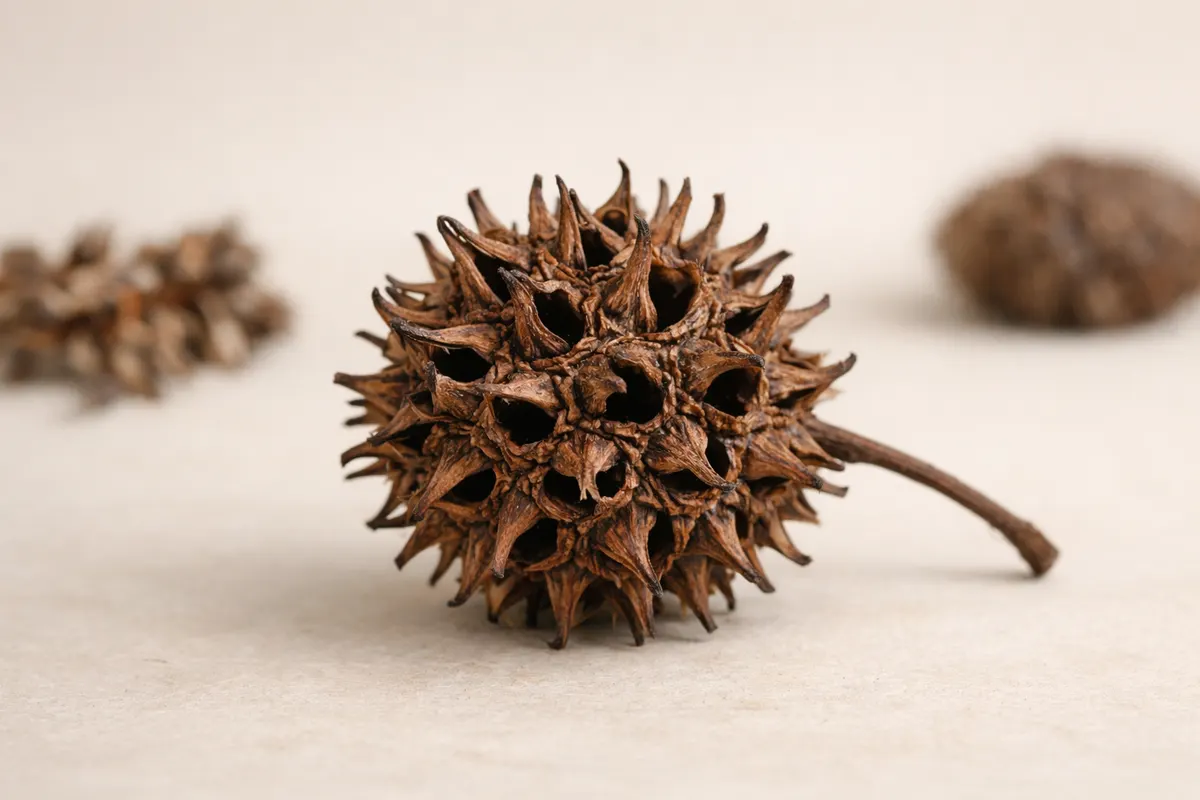
What are sweet gum tree balls and where they come from
Sweet gum tree balls are the hard, spherical seed capsules produced by Liquidambar trees (commonly Liquidambar styraciflua in North America). Each ball is a core of many small capsules covered in multiple sharp or blunt spines; they form after the tree flowers and hold dozens of tiny winged seeds that disperse when the capsule breaks apart.
Typical intact balls range from about 1.5 to 3.5 cm (roughly 0.6–1.4 in) in diameter, though older, broken, or matted specimens on the ground may be larger in visual spread because of attached debris. The surface is woody and rigid, not fleshy, and the attachment point to the twig is usually a short, woody stem rather than a stalked pod.
Liquidambar is in the Altingiaceae family. In temperate urban and forest settings it is known for its star-shaped leaves in summer and often spectacular fall color; the seed balls are one of the tree’s most persistent diagnostic features in winter and early spring.
When you describe a candidate object as a sweet gum tree ball, compare size, spine density, and the twig or stem remnant. Those three cues together give the most reliable photographic signal short of microscopic seed structure or botanical sampling.
- Origin: seed capsule of Liquidambar (sweet gum) trees
- Typical diameter: 1.5–3.5 cm intact; can appear larger on the ground
- Surface: woody capsule with many spikes or nodules
- Attachment: short woody stem remnant at the top, not a fleshy peduncle
How can you tell a sweet gum tree ball from photos?
Start with overall shape and size — a near-spherical woody ball 1.5–3.5 cm across is a strong initial match. Close-up photos that include a ruler, coin, or leaf for scale make size checks straightforward and reduce guesswork.
Surface texture and the pattern of the spikes are critical. Sweet gum balls have many short, conical projections arranged in a roughly even pattern; the projections are rigid and woody, not soft or papery. Look for small openings or dried capsules where individual seeds once exited.
Check the attachment point. A short, stubby woody remnant or a small broken twig where the ball hung is typical; if the specimen has a long stalk or is attached inside a soft pod, it’s probably from a different species. Photos that capture both the sphere and any stem remnant are especially helpful.
Context clues in the photo — nearby leaves, the bark of the tree they fell from, or the typical five-pointed sweet gum leaf — add confidence. If a single image shows only a distant cluster of balls on the ground, try to get a close macro shot and one wider shot that includes the tree or leaf litter.
- Size with a scale: 1.5–3.5 cm across
- Spikes: short, woody, conical projections in even pattern
- Attachment: short woody stem remnant, not fleshy
- Context: star-shaped sweet gum leaves, peeling bark, or cluster on twig
Key facts about sweet gum tree balls
The table below lists compact, quotable attributes that are visible or easily reported from a photograph. These are the most practical features to note when trying to confirm a candidate as a sweet gum tree ball.
Use this as a checklist: when most rows match the object in your photo, the identification is likely; if multiple rows conflict, collect more angles or contextual shots before concluding.
| Attribute | Typical detail |
|---|---|
| Size | 1.5–3.5 cm diameter intact (0.6–1.4 in) |
| Colour | Grey-brown to dark brown when dry |
| Surface | Woody capsule with many short conical spikes |
| Attachment | Short woody stem remnant at top; hangs singly or in pairs |
| Active season | Persists through fall, winter, and early spring |
| Distinguishing feature | Spherical, multi-spiked capsule that splits into seedlets |
- If several table attributes conflict with your specimen, a lookalike species may be the correct ID.
- Photographs alone can strongly support a match, but a single photo rarely provides absolute botanical confirmation.
Where and when you'll find sweet gum tree balls
Sweet gum trees are planted widely as street and ornamental trees and also occur naturally in mixed hardwood forests in parts of North America, Central America, and East Asia (different Liquidambar species). The seed balls persist on branches into winter and fall to early spring on the ground, so they are a common winter sight under mature trees.
Look for seed balls in areas with established shade trees, parks, older residential neighborhoods, and riparian edges where sweet gum is part of the canopy. They fall across a long season rather than a single event; wind, ice, and animal activity all influence when most balls come down.
When searching by photo, include a shot of the ground beneath a suspected tree and a close-up of the ball. The table below highlights typical regions, timing, and what to expect visually in each setting.
| Region / Habitat | When you'll see it | What you'll notice |
|---|---|---|
| Urban streets & yards | Autumn through early spring | Clusters under specimen trees; contrast with pavement and leaf litter |
| Parks and landscaped areas | Late fall into winter | Multiple balls beneath a single tree; often with fallen leaves |
| Mixed hardwood forests | Winter and early spring | Scattered individual balls among leaf litter and twigs |
| Riparian edges and older plantings | Fall to spring | Balls mixed with other tree detritus and seeds |
- In urban areas, expect concentrated litter beneath single specimen trees; in forests, balls may be scattered across a wider area.
- Balls remain visible through winter after leaves drop, making winter the easiest season to spot them.
Plants and pods commonly confused with sweet gum balls
Several other seed structures can look similar at a glance. Redbud pods (Cercis) are long and bean-like and therefore easy to rule out with shape, but some dried seed clusters from other trees and seed-bearing insects can create spherical debris that confuses non-specialist viewers.
Osage orange (Maclura pomifera) fruit is often cited by readers; it’s much larger (several inches across), soft-textured, and green to yellow when fresh — a clear mismatch if you include scale and texture in your photo. Maple samaras are winged and flat, not spherical, and usually appear in paired helicopter wings attached to a twig.
Below are the tell-tale photographic differences to check: size and texture usually separate these lookalikes from authentic sweet gum tree balls, and an attached leaf or twig remnant often resolves the question.
- Osage orange: much larger, soft/brain-like surface — not a match if your specimen is under 4 cm.
- Maple samaras: flat, winged seeds — easily ruled out by shape.
- Redbud pods: elongated bean pods on long stalks — different attachment and form.
- Seed clusters or fungus balls: vary in texture; note whether the surface is woody and spiny (sweet gum) or soft/papery.
Care and handling of collected sweet gum tree balls
For casual handling and educational collections, dry seed balls are stable and pose little biological risk; they are woody and durable. Wear gloves if you are sensitive to dry plant material or if the spikes catch on skin or clothing when gathering specimens.
If you plan to keep specimens for study, label them with date and location, and store in a dry container to prevent mold. Do not assume seeds are viable based solely on an intact capsule; viability testing or careful germination trials are needed to confirm whether seeds will sprout.
Avoid moving large quantities of seeds into new areas if you are concerned about spreading non-native trees. If local regulations restrict tree movement or planting, follow municipal guidance — this page does not provide legal advice on planting or removal.
- Wear gloves for collection to avoid pricks or skin irritation.
- Store labeled specimens dry and away from pests.
- Do not use this information as legal advice about moving plant material.
Frequently asked questions
What are spiky seed balls when I find them scattered on my lawn?
When you find spiky seed balls scattered on your lawn, they are most likely the woody seed capsules of a sweet gum (Liquidambar) tree if they match the size (about 1.5–3.5 cm), have many short conical spikes, and show a small woody stem remnant. Check nearby trees for characteristic star-shaped leaves or bark; if those are absent, take a close macro photo including a size reference and compare the surface texture—woody, not soft or papery—to rule out lookalikes.
How can I safely tell if a round seed ball belongs to a sweet gum tree?
Safely distinguish a sweet gum seed ball by photographing the sphere with a scale, capturing the spike pattern, and showing any stem remnant. Confirmatory cues include consistent spike density around the ball, a hard woody feel (when handled with gloves), and nearby sweet gum leaves or bark. If the object is much larger than 4 cm, soft, or brain-like in texture, it’s not a sweet gum ball.
What are sweet gum balls uses for gardeners deciding whether to compost or mulch them?
Sweet gum balls can be composted or mulched but take longer to break down because of their woody structure. For composting, shred or break them into smaller pieces to speed decomposition; for mulch, note that intact balls persist and can be a trip hazard on paths. If you plan to move many balls, check local planting guidelines to avoid unintentionally spreading trees where they may be unwanted.
Can pets eat sweet gum tree balls and are they toxic?
Sweet gum tree balls are not commonly listed as highly toxic, but they are woody and can be a choking or intestinal obstruction hazard to pets if chewed or swallowed. Keep pets from chewing on them, supervise animals in yards with heavy sweet gum litter, and contact a veterinarian if you suspect ingestion. This guide does not replace professional medical advice for animals.
Related guides
Compare your photo to the Sweet Gum Ball clues with Seed Identifier - Seedio
After you’ve checked size, spike pattern, and attachment points, use Seed Identifier - Seedio as an optional next step to compare your photo against these visual clues. Treat the app’s result as an initial match rather than definitive verification; if you need further confirmation, supplement the app with close-up photos and contextual shots, or consult a local botanist. Visit https://seedidentification.app/ to learn more about the identification tools available.
Take the next step →