

Grass Seed Heads: Spikes, Panicles, Awns, and Seed Clues
Learn which grass seed heads details a photo can prove, which it cannot, and the follow-up checks worth doing before you rely on the answer.
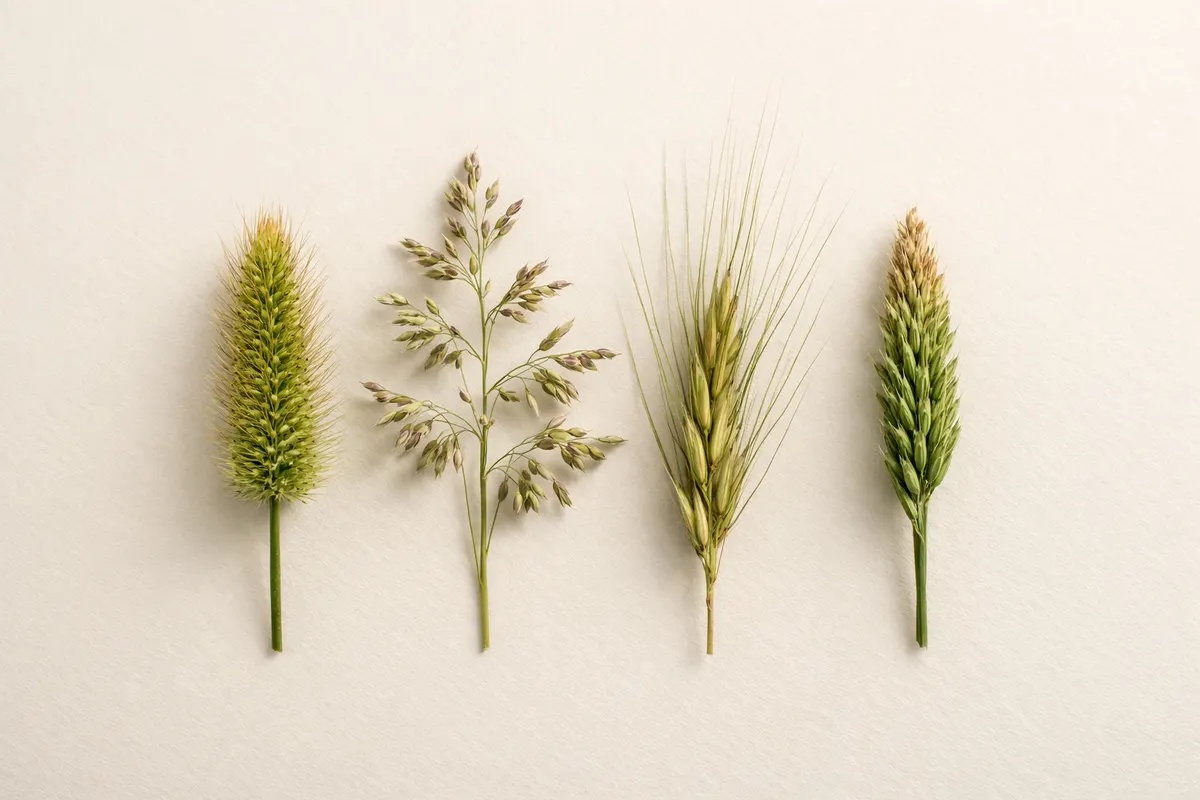
Quick summary: identifying grass seed heads
Grass seed heads are one of the most useful features for narrowing grass identifications from photos, but they rarely give absolute proof on their own. Look first for the seed head type—spike, panicle, raceme—and the presence or absence of awns (bristle-like extensions) because those traits are structural and usually visible even in imperfect images.
Other strong immediate clues include spikelet arrangement (dense vs. open), whether florets are flattened or cylindrical, and the overall size and posture of the seed head—erect, nodding, or drooping. These architectural clues are more reliable than color or tiny surface hairs, which change with light and seed maturity.
Realistically, a single photo of a seed head can point you to a small group of likely species or genera (for example: ryegrasses, fescues, panic grasses, or some brome/rye types), but it rarely settles a species-level ID without leaf, ligule, or habitat context.
Best immediate actions: note the seed head type, whether awns are present and how long they are, capture photos from multiple angles (close-up of a spikelet and a wider plant-in-context shot), and record location and date. Treat any single-photo ID suggestion as a research lead, not a final answer.
- Seed head type (spike, panicle, raceme) is the most useful single clue.
- Awn presence/length is a stable structural trait worth photographing.
- Spikelet density and orientation help separate common groups.
- Color alone is a weak indicator—age, season, and light change it.
- Use multiple angles and add leaf/ligule context before trusting an ID.
Strong visual clues to inspect on grass seed heads
When you photograph grass seed heads, prioritize clues that don’t vanish with minor blur or shadow. The seed head’s overall architecture—whether the flowering structure forms a tight spike, an open panicle with branching, or a single-sided raceme—is usually visible even at modest resolution and filters out many lookalikes.
Awns are another robust clue. These bristle-like projections attach to lemma tips and differ by presence (none, short, long), number (single vs. paired), and curvature (straight, bent, twisted). For example, many wild rye and barley relatives show long, obvious awns; orchardgrass and many panic grasses do not. Measure or estimate awn length in relation to the spikelet to make comparisons.
Spikelet arrangement and glume shape are higher-resolution but still generally visible in phone photos if you shoot a close-up. Look at whether spikelets sit directly on the stem (sessile) or hang on tiny stalks (pedicelled), whether they’re compressed side-to-side or rounded, and if paired spikelets occur. These differences reliably separate groups like fescues (usually single, compressed) from some panic grasses (branched panicles with pedicelled spikelets).
Contextual clues strengthen morphological evidence. Note the plant’s height and habit (tufted vs. spreading), substrate (lawn, roadside, wetland), and flowering season. A drooping, loose panicle on a tall tufted plant in late summer will lead you down a different set of likely species than an erect, dense spike in spring on short turf.
Good practice: include these shot types—(1) whole plant from a meter away to show habit, (2) a lateral view of the whole seed head, and (3) a macro of one spikelet including any awns. These three perspectives capture the strongest clues without specialized gear.
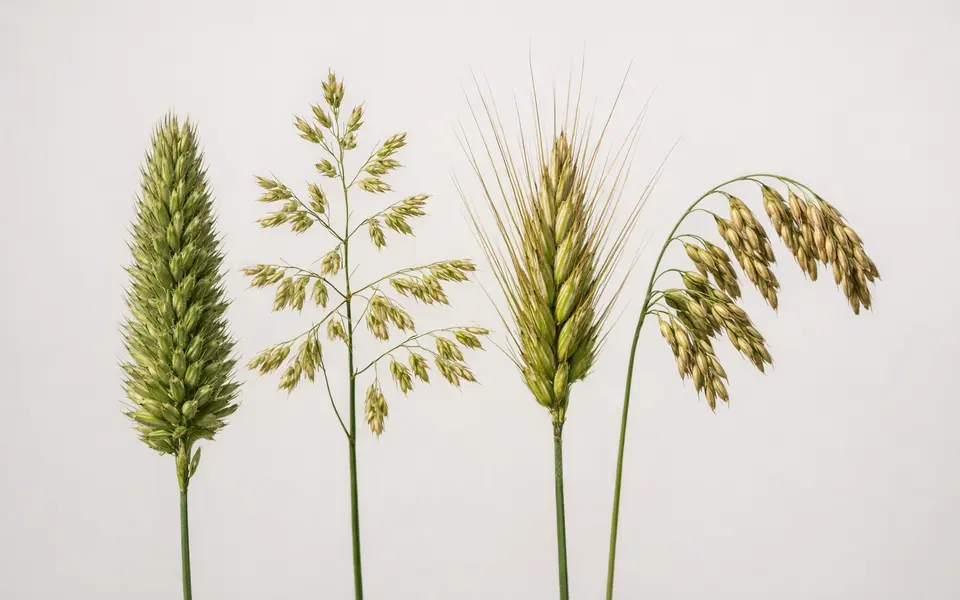
- Seed head architecture: spike vs. panicle vs. raceme.
- Awns: presence, length relative to spikelet, and curvature.
- Spikelet attachment: sessile (on the stem) vs. pedicelled (stalked).
- Glume and lemma outline: compressed vs. rounded spikelets.
- Plant habit, height, and habitat notes for context.
Common weak signals and photo traps for grass seed heads
Color is one of the most misleading cues in grass photos. Seed heads darken and desiccate with age, pigments vary by sunlight, and camera white balance skews hues. A yellowish head can simply be older or sun-scalded, not a different species. Avoid using color as a primary identification trait.
Tiny hairs, subtle surface textures, and very short awns are often invisible or misrepresented in smartphone pictures. Look for these only if you can get a clear macro with scale; otherwise treat them as tentative notes. Similarly, glossy reflections, backlighting, and shallow depth of field can hide key silhouette details or make a spikelet look flattened when it isn’t.
Scale and perspective mistakes are common. Without a familiar object for size, awn length and spikelet size are hard to judge. Photos taken too close with a wide-angle lens distort proportions; photos taken too far lose spikelet detail. Always include at least one photo with a ruler, coin, or a recognizable leaf for scale when possible.
Convergent shapes create persistent lookalikes. Several unrelated grasses form narrow, upright spikes that resemble each other to a casual observer. For instance, several Bromus, Hordeum, and Elymus relatives share compact spikes or nodding panicles that confuse early identifications. That’s why combining seed head clues with leaves, ligules, and habitat is essential.
- Color shifts with age and light—don’t overinterpret hue.
- Fine hairs and tiny awns need a clear macro to be reliable.
- Lack of scale makes size-based clues unreliable.
- Wide-angle close-ups distort proportions; use neutral perspective.
- Different genera can produce similar spike shapes—check other traits.
How to compare likely grass seed head matches
A systematic comparison reduces guesswork. Start by sorting candidate matches by seed head architecture: group all spike-forming candidates separately from open panicle types. This first filter typically cuts the candidate list dramatically. Next compare awn presence and relative length, then spikelet attachment and shape.
Use a three-photo checklist for each candidate: whole-plant habit, a side view of the seed head, and a macro of a single spikelet. Lay your photos beside reference images and tick off matched features in that order: architecture → awns → spikelet attachment → glume/lemma shape → habitat fit. Fewer mismatched traits equal a stronger candidate.
Record dissimilarities as much as matches. For example, if two species share a dense spike and long awns but one typically grows in saline soils and your specimen is mid-lawn, downgrade that species. Habitat mismatches often rule out visually similar species. Seasonality is also important—some grasses only flower in early spring, others in late summer.
When possible, cross-check leaves and ligules. Ligules (the membranous or hairy appendage at the leaf-sheath junction) and leaf blade texture often clinch identifications that seed heads alone cannot. If you can collect a small sample, compare ligule type and leaf edge—these anatomical traits are less variable from photo to photo than color or minor surface texture.
Keep a short ranked list of 2–4 candidates and treat identification as hypothesis testing: look for one or two decisive traits that would eliminate each alternative. This approach keeps you from anchoring on the first plausible match and reduces the risk of overconfident identifications.
- Filter by seed head architecture first, then compare awn traits.
- Use three standardized photos per specimen for consistent comparison.
- Score matches in order: architecture → awn → spikelet attachment → habitat.
- Use habitat and season to eliminate visually similar species.
- Add leaf and ligule checks to move from likely genus to plausible species.
Using Seed Identifier - Seedio after your visual checklist
Once you’ve recorded the strongest clues—seed head type, awn presence/length, spikelet attachment, and good habit shots—use Seed Identifier - Seedio as a research companion. The app can help surface similar species and show additional reference photos that highlight small but diagnostic differences you might have missed.
Treat the app’s suggestions as candidate hypotheses rather than final answers. Compare the app’s top matches against your prioritized checklist: does the proposed species share the same seed head architecture, awn configuration, and habitat notes? If several features line up, the app’s suggestion is worth deeper investigation; if not, use the app’s image examples to identify which trait differs.
When using the app, add your own metadata: record the location, date, and any habitat notes or leaf photos. These details improve the value of the suggestion as a research lead. If a suggested match would have different ligule or leaf traits, use that discrepancy to guide additional photos or local field checks rather than accepting the ID immediately.
If uncertainty remains after app suggestions, treat the result as a research note. Share the ranked candidates, your photos, and the key mismatches with a local extension service, botanic garden forum, or regional plant group for confirmation. This two-step workflow—clue checklist then app-assisted comparison—keeps identifications grounded in observable structure and local context rather than in a single algorithmic readout.
- Use the app to surface candidate matches after you document core clues.
- Compare each app suggestion to your checklist before trusting it.
- Attach location, date, and leaf photos to make app results more actionable.
- Use app results as leads—seek local expert confirmation when needed.
- Treat any single app suggestion as a starting point, not a final verdict.
Related guides
Try Seed Identifier - Seedio after your clue checklist
When you’ve documented seed head architecture, awns, spikelet detail, and a plant-in-context photo, use Seed Identifier - Seedio to surface nearby matches and example photos for the species your clues suggest. Treat results as research leads: compare app suggestions to the traits you recorded, add leaf and ligule photos if needed, and record location and date. If the app narrows to a small set of candidates, consider those notes useful starting points for local confirmation rather than final IDs.
Take the next step →Frequently asked questions
Can I identify a grass species from one seed head photo?
A single seed head photo can often narrow the field to a few genera or groups, especially if the photo clearly shows architecture and awns, but it rarely proves a species-level identification alone. For confident IDs you’ll usually need supporting evidence such as leaf shape, ligule type, habitat, and sometimes seasonality or multiple specimens.
What’s the difference between a spike and a panicle in grass seed heads?
A spike is an unbranched inflorescence with spikelets attached directly to the central stem, giving a compact columnar look. A panicle is branched, often open and airy, with spikelets on stalks that radiate from central branches. This structural difference is one of the fastest ways to exclude many lookalikes in photographs.
How important are awns for identification and how should I photograph them?
Awns are highly informative when present: note their presence, number, relative length, and curvature. Photograph a lateral close-up of a spikelet with a small scale object nearby (ruler or leaf) so you can estimate awn length. If awns are very short or absent, document that clearly—absence is itself a trait that narrows candidates.
If an app suggests a match but I’m unsure, what should I do next?
Use the app’s suggestion as a hypothesis and compare it against your photographed clues. Look specifically for mismatches in seed head architecture, awns, spikelet attachment, ligule type, and habitat. If uncertainty persists, seek a second opinion from a regional plant group, extension service, or a botanical forum and share the photos and your checklist of matched and mismatched traits.