

Milkweed Seed Pods: Shape, Fluff, Seeds, and Timing Clues
Learn which shape, seed, fluff, and timing clues matter for milkweed seed pods, plus comparison steps and safe next checks before confirming ID.
Quick answer for milkweed seed pods
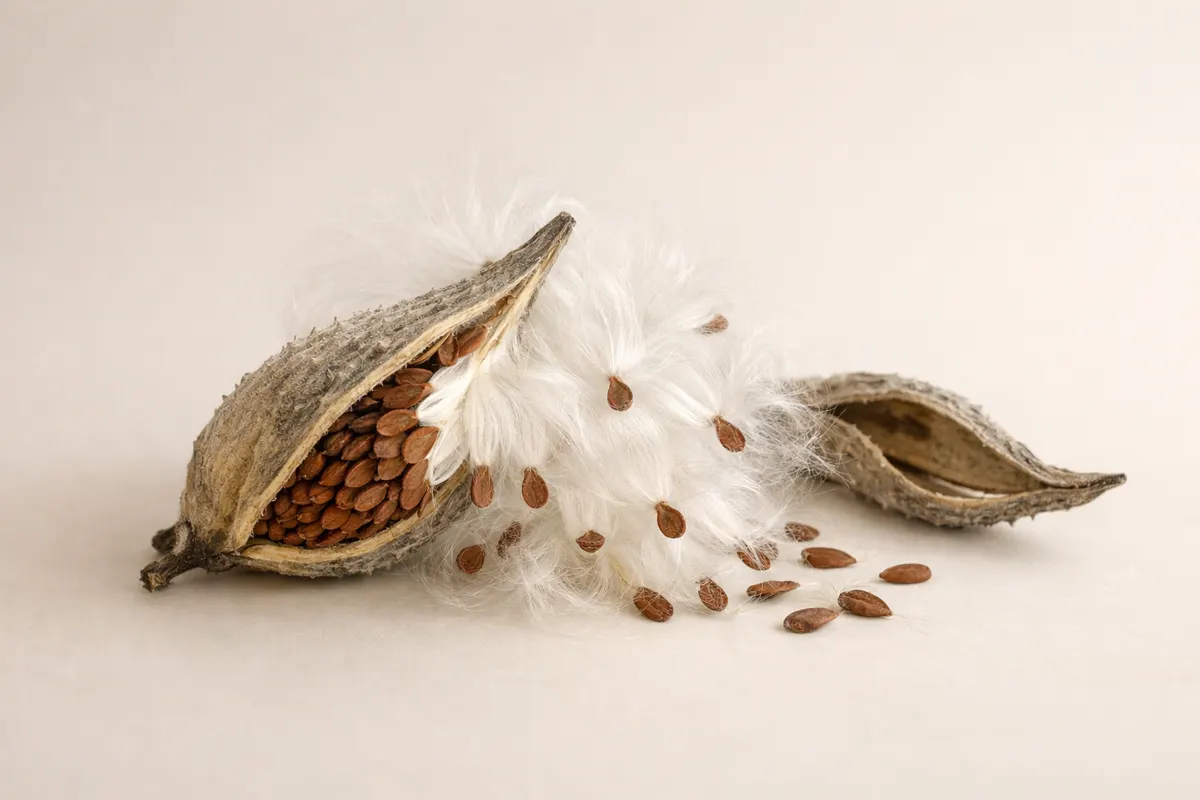
Milkweed seed pods most reliably show their identity through a combination of shape, how they split, and the flat seeds with silky floss (coma) inside. Look for elongated or ovoid pods that split open along a seam to release many flat, brown seeds attached to white silky hairs.
Timing is a strong contextual clue: pods that are firm and closed in mid to late summer often ripen and split in late summer through fall, releasing a mass of floss that catches wind. If you see pods already shedding fluff, you’re looking at mature pods rather than developing fruit.
Single visual clues—like a hairy exterior or a rounded shape—can mislead. The most useful quick checks are pod length and profile, the presence and arrangement of flat seeds with attached floss, and how the pod dehisces (splits). Combine those with nearby leaves, flowers, and habitat to get a practical preliminary ID.
A final, cautious note: a single photo or one clue rarely proves species-level identity. Treat clear visual matches as strong candidates and uncertain ones as notes for further comparison or scanning with an ID tool.
- Look for elongated or ovoid pods that split along a seam
- Check for flat, brown seeds with white silky floss inside
- Use season and whether pods are shedding fluff as timing clues
- Combine pod clues with leaves, flowers, and habitat for better matches
Strongest visual clues
Shape and profile: Many milkweed pods (Asclepias and related genera) are spindle-shaped to ovoid—longer than wide with pointed ends—or broadly ovoid like a small football. Measure or estimate length in your photo: common garden species often have pods 3–10 cm long, which is a useful anchor for comparison.
How the pod opens: Milkweed seed pods typically split open along one seam (a dehiscing follicle) or a paired seam to expose rows of flat seeds. When mature, the seam will part and reveal a neat interior of overlapping seeds framed by floss. That clean, seam-first opening pattern is more diagnostic than pod color alone.
Seeds and floss: The seeds themselves are flat, teardrop- or oval-shaped, and brown to tan. Each seed attaches to a tuft of fine, silky hair—the coma—that looks like white fluff. In close-up photos, the combination of flat winged seed and dense silky hairs is a strong identifier.
Surface texture and thickness: Pod walls that look leathery or slightly woody (not thin and papery) often point to true milkweeds. Many lookalikes have thinner or papery capsules that crumble or open irregularly rather than splitting cleanly on a seam.
Contextual cues: Leaf shape, leaf arrangement, flower type (if present), and habitat are strong supporting evidence. Milkweeds commonly occur in open fields, roadsides, and prairies; pairing pod clues with a photo of the plant’s leaves and flowers improves certainty.
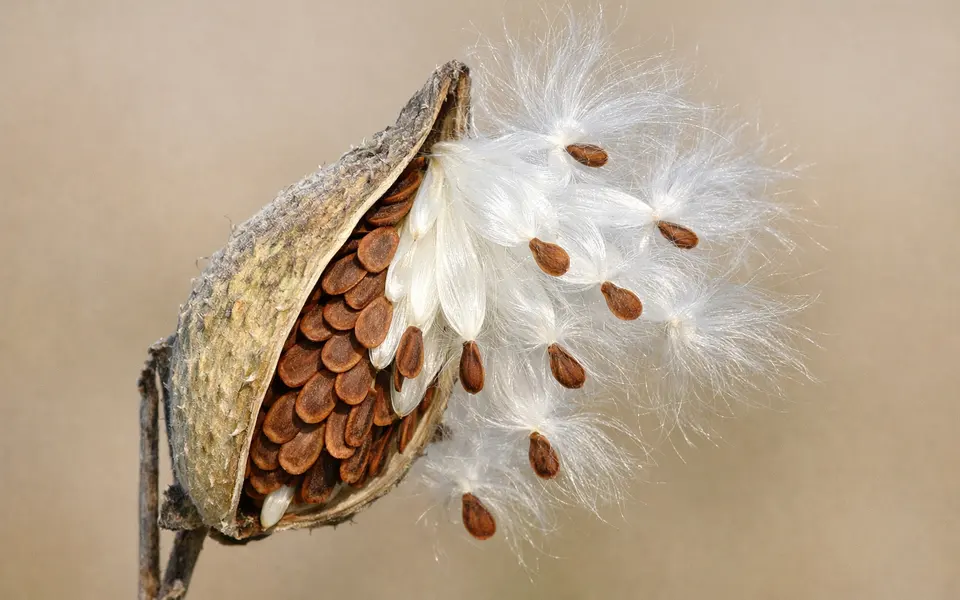
- Pod profile: spindle or ovoid, often longer than wide
- Dehiscence pattern: seam-first opening revealing seeds and floss
- Seed anatomy: flat, brown seeds each with a tuft of white silky hair
- Pod wall: leathery or slightly woody rather than papery
- Plant context: leaf shape, flowers, and habitat for confirmation
Weak signals
Color alone is unreliable. Pod color ranges from green to brown to gray as they mature; lighting and drying change hues dramatically. A brown pod might be old milkweed, or it could be a different species entirely that simply dried earlier.
Single-angle photos and extreme zooms can hide telling features. For instance, a close-up of fluff without showing the seed’s flat profile or the pod seam leaves too many possibilities. Glare, shadow, and backlighting can distort apparent texture and edge sharpness.
Small size or fuzzy surface texture without seed/seed-hair detail is weak evidence. Some plants develop hairy or ridged fruits that look superficially similar to milkweed pods but release seeds differently or have very different internal seed structures.
Counting seeds from a single partially opened pod is risky. Seed number varies by species, by pod maturity, and by damage from insects or weather. Use seed count as a supporting note, not as a decisive feature.
- Don’t rely on pod color alone—lighting and age change color
- Avoid ID from a single close-up of fluff or pod surface
- Surface hairiness without seed details is a weak clue
- Seed counts vary; use them as supporting, not definitive, evidence
Comparison workflow
Start with a basic checklist in your phone photo set: one wide shot showing the plant and habitat, one mid-range shot of the branch or pod cluster, and one close-up of the pod’s split interior and the seeds. These three views cover context, pod form, and the definitive seed-and-floss detail.
Next, note timing and condition: record the date, whether the pod is closed, splitting, or actively shedding fluff, and whether nearby flowers are present or gone. Milkweed flowers appear earlier in the season; pods forming after a flowering period match expected development timelines.
Compare your observations against species notes: measure pod length from a known object in the photo (a coin, ruler, or even a thumb) and check if it fits typical ranges for likely species. Combine length with pod profile, seam pattern, and seed appearance to narrow to a candidate group rather than a single species.
Use elimination: rule out lookalikes by differences in how they open or where they grow. For example, capsules that shatter or split irregularly, or seeds that are round rather than flat, point away from milkweed. Keep a short list of 2–3 candidates and capture additional images if possible before final judgment.
- Photograph: wide plant + mid-range pod cluster + close-up interior
- Record date and pod condition (closed, splitting, shedding)
- Measure pod length using a scale object in your photo
- Eliminate lookalikes by how they open and seed shape
- Narrow to 2–3 species candidates before accepting a match
App workflow
After you collect the checklist photos and notes, use Seed Identifier - Seedio as a first-pass scanner. Submit clear images showing the pod interior and a context shot so the algorithm has both the seed detail and the plant-habitat clues it needs. Treat app results as candidate matches, not final proof.
Interpret app suggestions alongside your checklist. If the app returns a likely milkweed species that matches your pod profile and timing notes, that strengthens the ID. If suggestions conflict with visible seam patterns or seed shape, trust the physical clues and gather additional photos rather than assuming the top suggestion is correct.
If results remain uncertain, use local resources next: regional wildflower guides, extension services, or community plant ID groups can confirm species-level identification. For broader context on seed and pod clues, our article on Wildflower Seeds: Heads, Pods, Fluff, and Shape Clues offers useful parallels when comparing similar plants.
Keep a research log: treat uncertain app matches as specimens to re-check in different seasons or under magnification. Avoid handling seeds or pods excessively, and do not assume anything about edibility, toxicity, or provenance from a single scan.
- Scan only after collecting wide, mid-range, and close-up images
- Treat app matches as candidates; confirm with physical clues
- Use regional guides or experts when species-level certainty matters
- Log uncertain results as research notes and re-check later
Related guides
Next step: scan your clues with Seed Identifier - Seedio
After you gather photos showing pod shape, the split seam, and the flat seeds with floss, try Seed Identifier - Seedio as a first-pass scan. Treat any match as a research note—confirm with leaves, flowers, local guides, or experts before deciding species-level identity.
Take the next step →Frequently asked questions
When do milkweed seed pods usually open and release fluff?
Milkweed pods typically mature and split from late summer into fall, with many species releasing their silky floss during dry, windy conditions. Regional climate shifts the exact timing; in warm areas pods can begin opening earlier, while cool or wet seasons delay dehiscence.
What features most clearly separate milkweed pods from lookalike seed capsules?
The clearest differences are how the pod opens (a neat seam that reveals overlapping flat seeds), the seeds’ flat profile with attached silky hairs, and pod wall thickness that’s leathery rather than papery. Lookalikes often have rounder seeds, papery walls, or irregular shattering rather than seam-first opening.
Can the amount of fluff tell me the species or how many seeds are inside?
Floss quantity shows that seeds are mature and ready for wind dispersal but doesn’t reliably indicate species or seed count. Seed number varies by species, pod maturity, and damage. Use floss as a maturity cue and inspect the interior seed arrangement for more informative detail.
Is it safe to handle milkweed pods and seeds?
Light handling of intact pods is generally safe, but avoid inhaling large amounts of freed fluff and wear gloves if you have skin sensitivity. Do not assume seeds or pods are edible or non-toxic; if you need to collect specimens for study, follow hygiene precautions and consult local guidance before using seeds for planting or consumption.