

Seed Identification
Types of Pine Cones: Identification, Habitat, Examples
Learn how to recognize common types of pine cones, which visible clues matter most, and where you're most likely to find each type in the landscape.
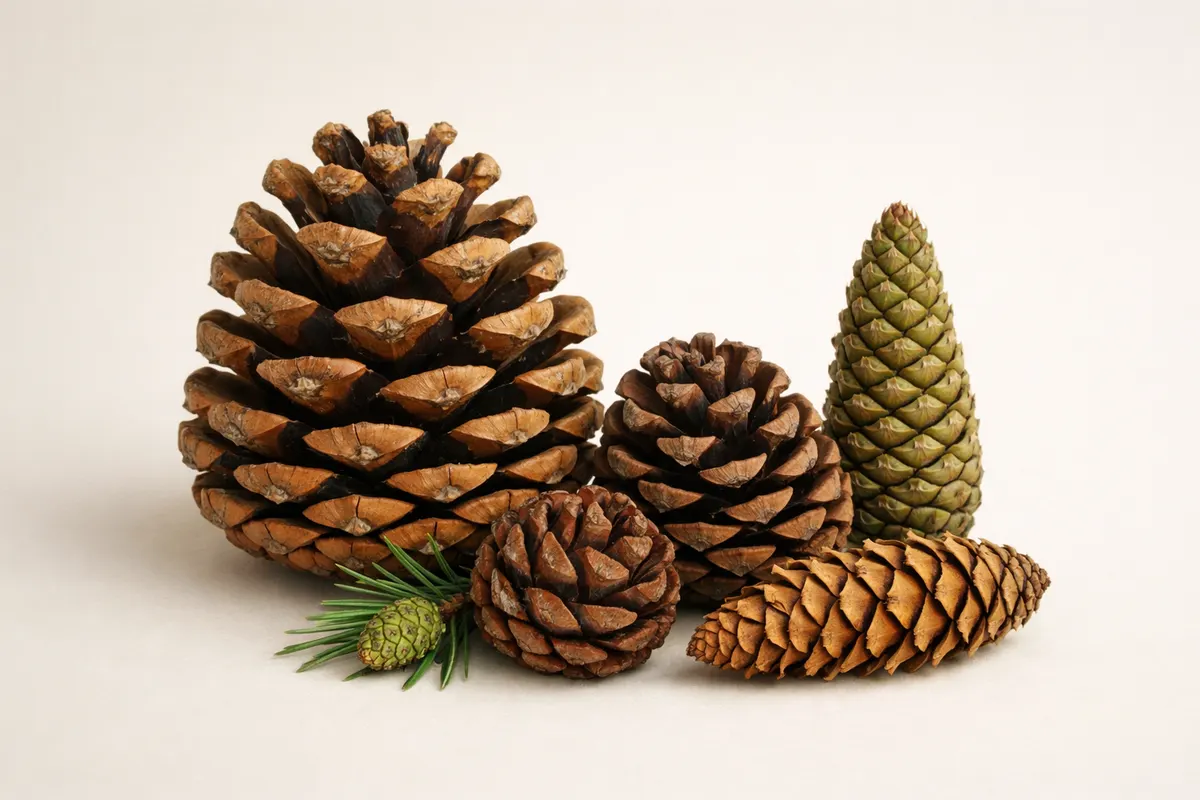
What a pine cone is and where it fits in the tree family
A pine cone is the seed-bearing reproductive structure produced by trees in the genus Pinus. In this article we treat “pine cone” as those seed cones produced by true pines (Pinus), not the cones of other Pinaceae members such as firs or spruces. True pines characteristically produce woody seed cones with overlapping scales that protect seeds until release.
Pine species vary a lot in cone size, shape, and surface texture. For example, eastern white pine (Pinus strobus) produces long, slender cones with flexible but woody scales; jack pine (Pinus banksiana) has smaller, often curved cones that can be woody and sometimes resinous; and lodgepole pine (Pinus contorta) typically has short, woody cones that are often prickled on the scales and remain woody rather than papery (NC State lodgepole pine account (https://plants.ces.ncsu.edu/plants/pinus-contorta/common-name/lodgepole-pine/)).
Naming the genus matters because the larger Pinaceae family includes firs and spruces whose cones behave differently: fir cones usually sit upright on branches and disintegrate on the tree, and spruce cones have thinner scales and commonly fall whole — they are lookalikes but not pine cones. Because cone form overlaps across species and regions, combine cone features with needle bundles and local range for the strongest ID.
AI-generated illustration, not a species-verified collection. Compare actual cone and needle features with the cited botanical references.
- True pine cones = seed cones of Pinus (woody scales, overlapping arrangement).
- Eastern white pine (Pinus strobus): long, slender, woody but flexible scales.
- Jack pine (Pinus banksiana): typically small, curved, woody cones, sometimes resinous.
- Lodgepole pine (Pinus contorta): short, woody cones often prickled on the scales (NC State (https://plants.ces.ncsu.edu/plants/pinus-contorta/common-name/lodgepole-pine/)).
- Firs and spruces are in the same family but their cones are not pine cones; fir cones disintegrate on the tree, spruce cones fall whole.
How can you identify a pine cone from a photo?
When identifying types of pine cones from a picture, focus on a short checklist of features you can reliably capture: cone length and width, overall shape (slender, ovoid, curved), the texture of scales (woody, prickled, resin-coated), how the cone sat on the branch (if visible), and associated needles (bundle size and length). Needle bundles of Pinus are diagnostic: count needles per fascicle (for example, eastern white pine has five needles per bundle).
Scale texture is often decisive. Many pine cones have clearly woody scales rather than thin, papery coverings. Lodgepole pine (Pinus contorta) and jack pine (Pinus banksiana) both produce cones with woody scales; lodgepole cones are short and often have small prickles on the scale tips, while jack pine cones are curved and can remain closed for long periods. For eastern white pine (Pinus strobus) the cones are long and slender with flexible but still woody scales; these differences can be seen in good close-up photos.
Because a cone alone is rarely conclusive to species, always try to capture contextual clues: a close shot of the needle bundle, a wider shot showing branch habit, and a photo of the tree’s bark or silhouette. If only a solitary fallen cone is available, note size with a ruler or a coin for scale and describe where you found it (forest type, elevation, latitude). These extra data points narrow options faster than cone shape alone.
- Photograph at least two scales in close-up and a full-cone profile for shape.
- Include a clear image of the needle bundle—count needles per fascicle when possible.
- Record scale texture: woody, prickled, resin-coated, or unusually thin.
- Note context: standing tree, branch position, habitat, and a size reference.
Key facts about common pine cone types
The table below summarizes typical attributes you can expect across common pine cone types and gives an example species for each attribute. These are generalized field cues: individual cones vary with age, exposure, and whether they opened to release seed.
Remember that pine cones are the seed cones of Pinus. Use needle bundle counts, cone scale texture, and geography together to make a reliable match; a single photo of a cone without needles or location is often ambiguous.
| Species | Typical cone clues | Needle bundles |
|---|---|---|
| Eastern white pine (Pinus strobus) | Elongated, slender seed cone with relatively flexible scales | Five needles |
| Jack pine (Pinus banksiana) | Small, often curved cone with woody scales | Two needles |
| Lodgepole pine (Pinus contorta) | Small woody cone, often with prickled scale tips | Two needles |
Where and when you'll see different pine cones
Pine cones occur wherever pines grow naturally or are planted. Timing depends on the species and whether you are looking at developing cones, recently opened cones, or older persistent cones. Some jack pine and lodgepole pine cones remain closed on the tree for years; do not impose a universal autumn-opening rule.
Use location as a strong filter: seeing a long, slender cone in the northeastern U.S. points quickly to eastern white pine, whereas short, prickled cones in western montane stands are more consistent with lodgepole pine. Always pair cone features with needle and tree habit when possible.
For species-specific development and seed-release patterns, consult the USDA Forest Service accounts for jack pine (https://research.fs.usda.gov/silvics/jack-pine) and lodgepole pine (https://research.fs.usda.gov/silvics/lodgepole-pine). Persistence and opening vary within lodgepole pine, so a closed cone alone does not identify the species.
| Region / habitat | When you'll see cones | What you'll notice |
|---|---|---|
| Eastern U.S. forests & parks | Varies with species and cone age; older cones may persist | Long, slender cones; needles in bundles of five (Pinus strobus) |
| Boreal and Great Lakes sandy soils | Varies with species and cone age; older cones may persist | Small to medium, often curved cones; two-needle bundles (Pinus banksiana) |
| Western montane and subalpine stands | Varies with species and cone age; older cones may persist | Short, woody cones often with prickles; two-needle bundles (Pinus contorta) (NC State (https://plants.ces.ncsu.edu/plants/pinus-contorta/common-name/lodgepole-pine/)) |
| Urban plantings and windbreaks | Varies with species and cone age; older cones may persist | Mixed cone types depending on planted species; check needles and bark |
Species and cone lookalikes to watch for
Several non-pine cones are commonly mistaken for pine cones. Fir cones (Abies species) typically sit upright on branches and disintegrate in place, leaving scales behind; you rarely find an intact fir cone on the ground. Spruce cones (Picea species) have thinner scales and generally fall whole — they can appear superficially similar but differ in scale thinness and branch attachment.
Because pine cones are seed cones of Pinus, do not treat fir or spruce cones as pine cones. Conifers in the same family can confuse the ID if you only look at a single detached cone; needle and branch context (upright versus pendent cones, needle shape and placement) separate these groups in photos.
Other lookalikes include some seed pods and fruiting structures from unrelated trees or shrubs that are irregular or woody. When in doubt, note whether the cone fell whole or disintegrated on the branch, count needles per fascicle if present, and compare scale texture: woody and overlapping for pines, thinner for spruces, and disintegrating for firs.
- Fir cones: upright on branch, disintegrate on tree — not pine cones.
- Spruce cones: thin scales, fall whole — look similar but different scale texture.
- Check needles and attachment: pine needles in bundles (fascicles) are the clearest tie to Pinus.
Care and handling of collected pine cones
If you collect a cone for study, dry it slowly in a ventilated, room-temperature place to avoid mold. Label where and when you found it, and record any nearby tree details (needle bundle count, bark photo, GPS location). Drying opens many cones and reveals seed and scale details useful for later comparison.
Handle cones gently: older cones may drop seeds and fragile parts when squeezed. If you plan to keep a specimen for reference, store it dry in a paper bag; plastic can trap moisture and encourage mold. Remember that a single cone rarely gives absolute species certainty—documenting needles, bark, and location increases confidence.
- Dry cones in the open air; avoid sealed plastic until fully dry.
- Label specimens with date, location, and nearby tree notes.
- Use a ruler or coin for scale photos to help later ID comparisons.
Frequently asked questions
Can I do pine cone identification from a single photo of a fallen cone?
You can often narrow a fallen cone to a small set of pine species from a single photo, but species-level certainty is rare without needles or location. A single cone can show scale texture, size, and shape that point toward groups (for example, short prickled cones suggest lodgepole), but pair that photo with a needle fascicle shot, a branch habit photo, or location details to increase confidence.
When should I use conifer cone identification instead of a pine-only approach?
If you cannot tell whether the cone came from a Pinus tree (no needles or branch context), use a broader conifer cone identification approach: check whether the cone sat upright or pendent on the branch, whether it fell whole or disintegrated, and the scale thickness. Fir cones that disintegrate on the tree or spruce cones that fall whole indicate a non-pine conifer rather than a true pine.
Why do cones from the same pine species look different from one another?
Cone appearance varies with age, sun exposure, and local growing conditions. Cones that open to release seed look different from freshly harvested, closed cones; large seed crops can make cones more numerous. Damage, resin, and insect activity also change scale texture and color, so compare multiple traits rather than a single characteristic.
Are fir and spruce cones the same as pine cones when I find one on the ground?
No. Fir and spruce cones are not pine cones. Fir cones usually break apart on the tree and you rarely find an intact fir cone on the ground; spruce cones fall whole but have thinner scales than pines. Always check attachment and scale thickness as clues that separate firs and spruces from true pines.
Related guides
Investigate a tentative cone identification
Explore Seedio (https://seedidentification.app/) for a photo-based identification suggestion. Compare the suggested species with the cone, needle bundles, and location; a fallen cone alone may leave several possibilities.
Take the next step →