

Wildflower Seeds: Heads, Pods, Fluff, and Shape Clues
Use visible photo clues, context, and a step-by-step comparison plan to evaluate wildflower seeds and know what a single image can — and cannot — prove.
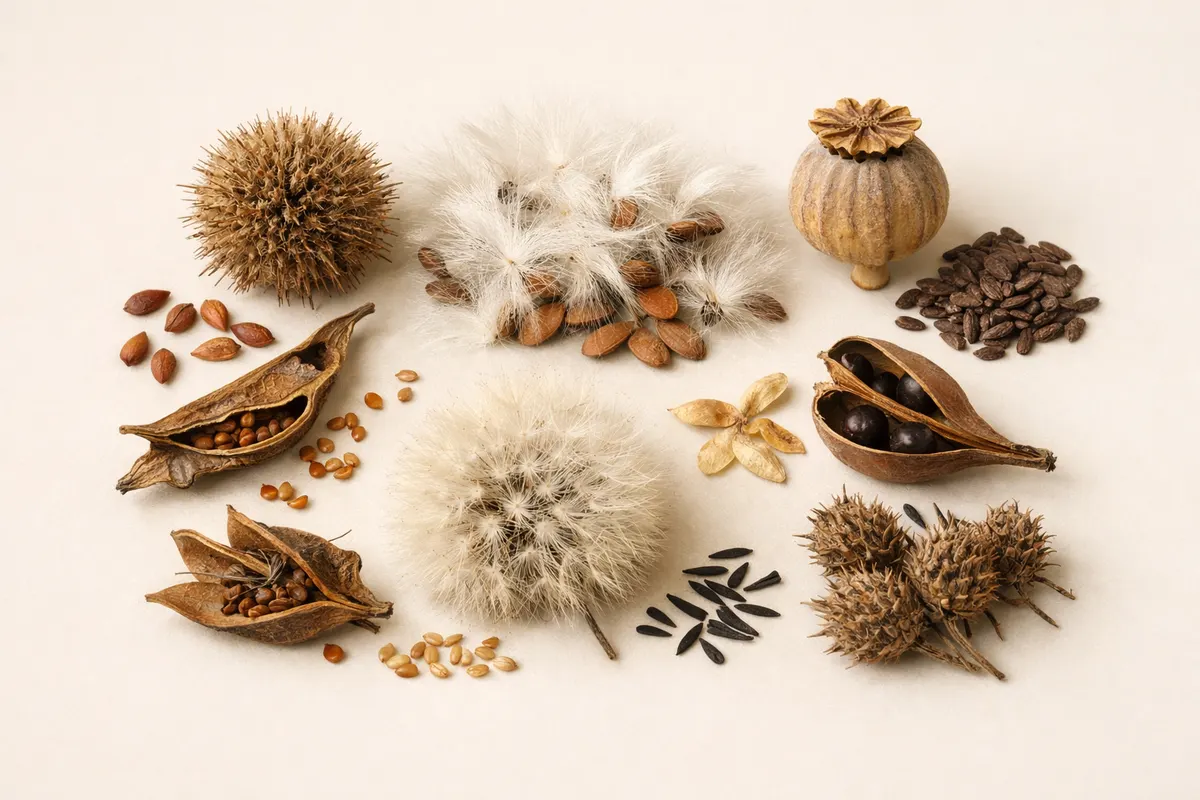
Quick answer for wildflower seeds
Wildflower seeds come in many tiny packages, and a single photo rarely gives absolute proof. The best photo clues for wildflower seeds are shape, surface texture, remnants of the seed head or pod, and the plant context (where and when you found them). Those clues help narrow possibilities from hundreds to a handful of likely groups.
Shape and scale are often the strongest signals. Is the seed elongated like a grass grain, round like a peppercorn, or flattened and winged? Surface texture—smooth, pitted, ridged, or fuzzy—also separates major groups. Remnants of the seed head or pod (for example, a papery capsule or a hairy achene) frequently point to families such as Asteraceae, Fabaceae, or Brassicaceae.
Context multiplies the value of visible clues. A small, hooked seed found late summer on a roadside is a different candidate list than the same seed found under a wet alder tree in spring. Note habitat, time of year, nearby leaves or flowers, and whether seeds came from a dried seed head, a pod you opened, or a wind-dispersed fluff.
Treat any single-photo result as a research lead, not a final ID. Use visible clues to develop a short list of likely matches, then compare those matches using multiple photos, reference descriptions, or a specialist resource before concluding.
Strongest visual clues
When you photograph wildflower seeds with a phone, prioritize clues that stay consistent across lighting and angle changes. These stable details are shape, size (with scale), attachment marks, seed-head architecture, and surface texture. Each narrows possibilities in a reliable way.
Always include a scale reference: a ruler, a coin, or a known leaf. Size bins—tiny (sub-1 mm), small (1–3 mm), medium (3–6 mm), large (6 mm+)—move you from dozens of lookalikes to a few families. For example, many Asteraceae achenes fall in the small to medium range and display a pappus or tuft at one end.
Attachment marks and pod remnants are high-value clues. A seed with a tiny stalk scar or a visible hilum (the seed’s attachment point) often tells you whether it came from a capsule, pod, or nutlet. Papery valves, split pods, or persistent calyx fragments will point toward specific genera.
Texture and ornamentation survive most phone photos better than subtle color. Look for ribs, pits, hairs, wings, or keel-like ridges. A flattened seed with a thin winged edge suggests certain millets and grasses; a ribbed, torpedo-shaped seed suggests members of the mustard family or some legumes.
Seed-head architecture—the way seeds are grouped on the plant—helps even when individual seeds look generic. Spiky burs, clustered achenes in a composite head, pods aligned along a stem, or a capsule that splits into valves are family-level signals you can often spot in background plant parts.
Fluff and dispersal structures (pappus, feathery hairs, or silky floss) are especially useful for wind-dispersed wildflowers. Presence, length, and attachment point of fluff can differentiate dandelion-like achenes from cottony milkweed or silky erodium seeds.
Combined clues are stronger than any single one. A small, ribbed, ovate seed with a persistent tuft and found at roadside in late summer is far easier to place than a plain brown dot photographed alone.
Photograph multiple views: one close-up of the seed, one showing the full seed head or pod, and one showing the plant habit or leaves nearby. Multiple angles reinforce which visual traits are intrinsic rather than photographic artifacts.
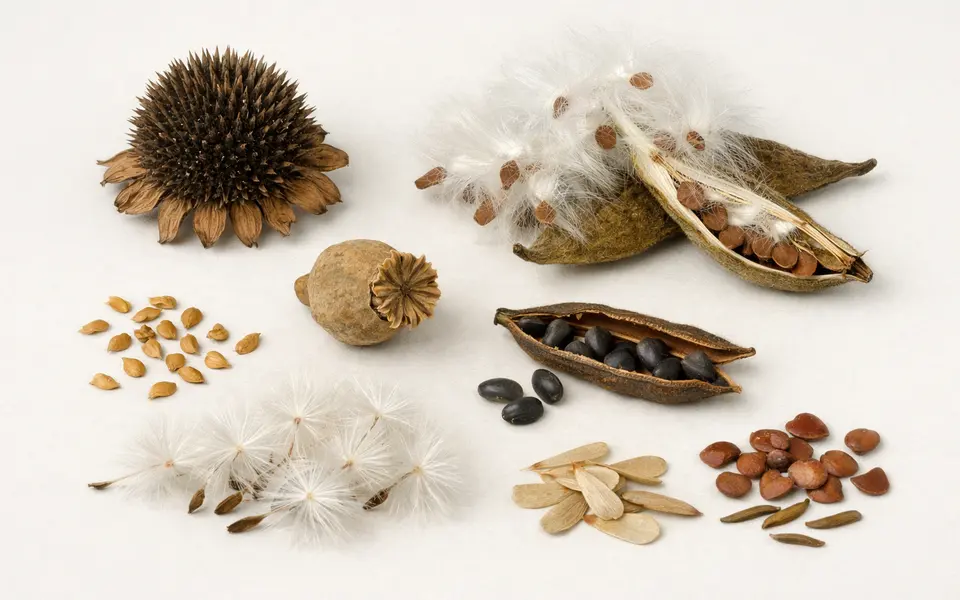
- Shape and profile: elongated, spherical, flattened, or winged — pick the strongest geometric impression.
- Size with scale: coin, ruler, or leaf for reliable measurement bins.
- Attachment and scar marks: hilum, funiculus remnant, or stalk base that reveals pod vs. capsule origin.
- Surface texture: smooth, pitted, ribbed, hairy, winged edges, or keel ridges.
- Seed-head architecture: composite heads, spikes, paired pods, or capsules that split open.
- Fluff and pappus: presence, length, and attachment location for wind dispersal clues.
- Multiple photos: close-up, context shot, and pod/head detail to separate real traits from glare or blur.
Weak signals
Some features look decisive in a single photo but are unreliable. Color, for example, shifts with light, camera auto-white balance, and seed age; it is useful as a supporting clue only. Small surface colors or sheen (metallic, glossy) are often artifacts.
Single-angle silhouettes and backlit photos can create false wings, flattened profiles, or exaggerated fluff. Dust, dirt, or residue can make seeds appear hairy or textured when they are smooth. Avoid trusting those signals without corroborating views.
Context misreads are common: seeds collected from a seed-head pile may include multiple species, so don’t assume a single seed represents the plant visible in the background. Also, seeds preserved inside dried pods differ in appearance from seeds once released and weathered.
Generic size impressions without scale are weak. Two seeds that look 'small' in a photo may differ by several millimeters in reality, a difference that matters between groups. Likewise, shape descriptors like 'kidney-shaped' or 'bean-like' are overused and can apply to many unrelated families.
- Color alone: variable and often misleading.
- Single-angle shapes: can hide wings or attached fluff.
- Surface sheen or dust: may mimic hairs or pits.
- Assuming one seed equals one plant: seed mixes or debris are common.
- No scale: ‘small’ is not precise enough for reliable grouping.
Comparison workflow
Turn your observations into a short, prioritized candidate list before trying to confirm an identity. Start with three strong filters: scale, morphology (shape + texture), and dispersal structure. Use those filters to produce a short list of 3–6 likely families or genera.
Next, compare each candidate against the photos you have. Use a consistent checklist: does the candidate typically show the attachment scar you observed? Are the seed-head remnants (capsule, pod, cone) consistent with the plant habit in your context photo? Does the seed’s surface match published close-ups?
If possible, gather one or two additional photographs focused on weak spots you noticed: an underside shot to see attachment scars, a wider shot to capture leaves or flower remnants, and a close-up of the seed head. Each additional image reduces the number of plausible matches.
When matches remain ambiguous, document your reasoning like a brief field note: list the clues that support each candidate and the clues that contradict it. This keeps future verification organized and makes it easier to consult books, herbarium images, or the linked internal resource on seed pods.
- Step 1 — Filter by size bin, dominant shape, and dispersal structure.
- Step 2 — Cross-check attachment scar and seed-head architecture against candidates.
- Step 3 — Add supporting photos: underside, whole-head, and plant habit.
- Step 4 — Record supporting and contradicting clues as notes for later verification.
- Use the internal reference: Seed Pod Identification by Photo: How to Read Pods, Seeds, and Plant Clues for deeper pod and attachment examples.
App workflow
After you assemble the visual clues and candidate list, use Seed Identifier - Seedio as a first-pass research tool. The app can help surface visually similar matches quickly, but treat its suggestions as leads—compare them to your checklist and local context before accepting any ID.
When using the app, submit clear photos that follow your checklist: a close-up with scale, a seed-head or pod shot, and a wider habitat shot. Avoid submitting only a single blurry or highly zoomed image; the app’s suggestions will be limited by the same photographic constraints that affect human readers.
If the app returns several plausible matches, use its suggestions to refine your notes. Are the suggested species consistent with the habitat and season where you found the seeds? If not, deprioritize them. If suggestions conflict, rely on attachment marks, seed-head architecture, and surface texture as tie-breakers.
Treat uncertain or low-confidence app results as research notes, not confirmations. For plants with safety concerns (possible toxicity or lookalike poisonous species), consult expert sources, local extension services, or botanical collections for verification before making decisions based on identification.
- Provide three photos: close-up with scale, pod/head detail, and habitat/plant habit.
- Compare app matches against your checklist, not against single-image impressions.
- Prioritize matches that align with season, habitat, and attachment characteristics.
- Use uncertain results as organized research leads; seek local confirmation for safety-sensitive cases.
Related guides
Use Seed Identifier - Seedio to turn clues into leads
After you check shape, scale, attachment, and seed-head clues, try Seed Identifier - Seedio to quickly surface visual matches. Treat the app’s suggestions as research leads: compare them to your notes, add photos if needed, and seek local confirmation for any safety-sensitive identifications.
Take the next step →Frequently asked questions
Can I identify wildflower seeds from a single photo?
A single photo can suggest likely groups but rarely proves a species. Use a single image only to generate a short candidate list; confirm with additional photos showing scale, attachment marks, and plant context or consult local experts for a reliable ID.
What if my seeds came from a seed mix or bag?
Seeds from mixes often contain multiple species and may be processed (cleaned, bleached, or polished), which removes attachment clues and fluff. Treat those seeds as probable matches rather than exact IDs; compare shape and texture to reference images and note that packaging information may be your best source.
How much does season and habitat matter for identification?
Season and habitat narrow possibilities dramatically. Certain wildflowers only set seed at specific times or in particular environments. Recording where and when you found seeds helps eliminate candidates that don’t match local phenology or habitat preferences.
Which photos should I take to improve identification chances?
Take at least three photos: a close-up of the seed with a scale reference, a photo of the seed head or pod showing attachment and arrangement, and a context shot showing surrounding leaves, flowers, or habitat. Multiple angles reduce ambiguity and improve both human and app-assisted matching.