

Seed Identification
Osage Orange: Identification, Habitat, and Real Examples
Learn which osage orange fruit features a photo can confirm, the lookalikes to watch for, and practical next steps before trusting a single image.
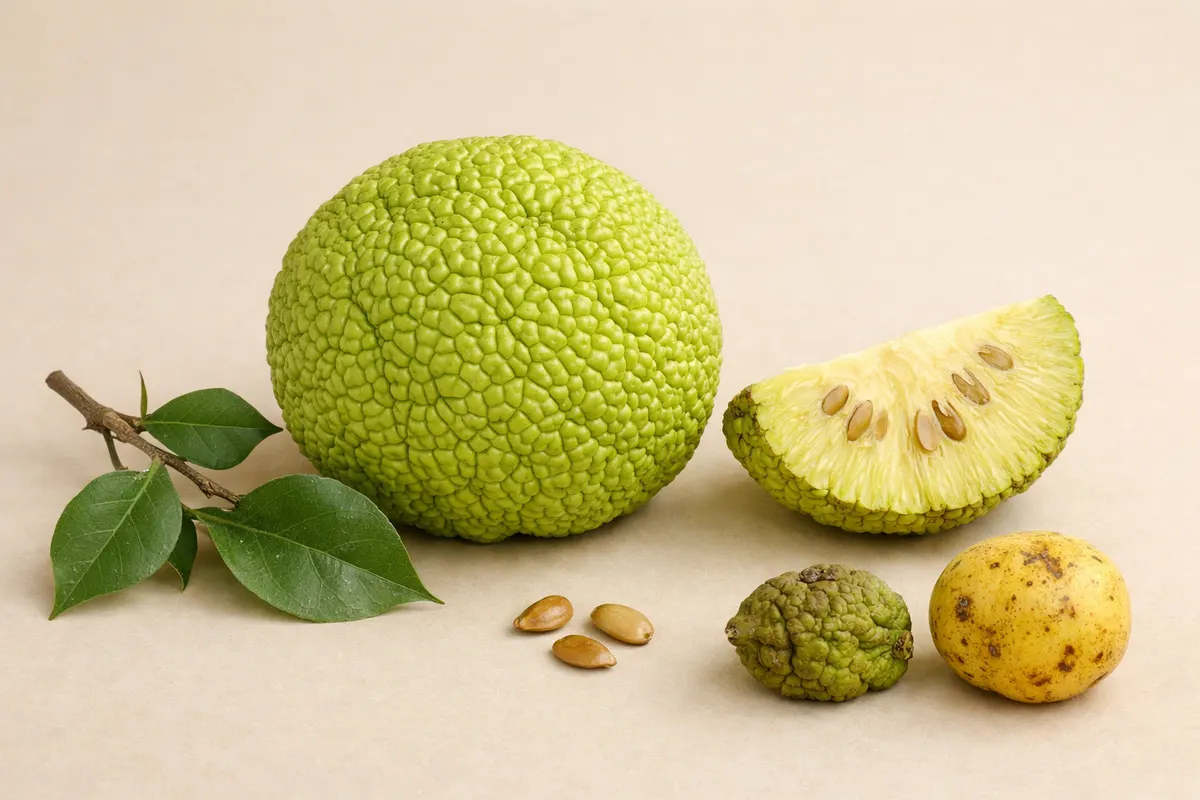
What an osage orange fruit is
An osage orange fruit is the large, bumpy, green fruit produced by Maclura pomifera, a small to medium deciduous tree in the mulberry family (Moraceae). Commonly 4–6 inches (10–15 cm) across, the fruit is dense, globular, and covered with a convoluted, brain-like surface. The tree itself reaches roughly 30–50 feet tall and is noted for its thorny branches and bright orange wood.
Native to parts of the south-central United States, osage orange was widely planted as living hedges and for windbreaks; it now grows across much of eastern and central North America as a naturalized species. The fruit is sometimes called a hedge apple or horse apple in regional usage, and its distinctive bumpy texture makes it easy to describe even if you don’t know the scientific name.
People photograph osage orange fruit because of the unusual surface and size, which are visible clues in casual photos. Keep in mind that a single image can strongly suggest this species but cannot prove species-level certainty—additional context like leaves, bark, or locale strengthens an identification.
How can you identify an osage orange fruit in a photo?
Start with overall shape and size: osage orange fruit are roughly spherical, 4–6 inches across, and often rest singly or in pairs on short stalks. The most diagnostic visual cue is the surface—an interlaced, lumpy, brain-like pattern of ridges and valleys that casts small shadows in side lighting.
Look for the tree clues that pair with the fruit. Osage orange leaves are simple, alternate, glossy, and about 3–6 inches long; bark is ridged with younger branches sporting sharp paired thorns. If the photo includes a twig with paired thorns and the orange-tinged wood or twisted ridges on bark, that raises confidence in the identification.
Assess photo quality and context: front-lit close-ups of the surface texture, a scale reference (hand, coin), and shots that include leaves or thorns are the most helpful. Blurry, overexposed, or tightly cropped fruit-only images can be ambiguous because other large green fruits show heavy texture when photographed poorly.
- Hedge apple identification tip: a 4–6 inch green fruit with a deeply convoluted surface and a single hard interior is typical of osage orange fruit.
- Surface: bumpy, brain-like ridges that form irregular lobes and shallow grooves.
- Size comparison: about the diameter of a softball to a small grapefruit—use a coin or hand for scale in photos.
- Context clues: paired thorns on small branches, glossy simple leaves, and orange-hued heartwood on cut branches support the ID.
- Limit checks: if seeds, flesh color, or smell are not visible, note that edibility and toxicity cannot be determined from a single image.
Key facts about osage orange fruit
The table below summarizes the most useful short facts a photo can convey. Use these attributes as a checklist when examining images: surface texture, size, coloration, and any visible tree features that appear with the fruit.
Photos that capture multiple attributes—fruit surface, a leaf, and a close-up of the branch—give the best chance of strengthening an identification without physical inspection.
| Attribute | Typical | Photo notes |
|---|---|---|
| Size | 4–6 in (10–15 cm) | Include a scale object (hand, coin) for reliable comparison |
| Color | Pale to medium green | Color shifts to yellow-brown with decay; avoid late-stage photos |
| Surface texture | Deeply convoluted, brain-like lobes | Side lighting highlights ridges and grooves |
| Seeds/inside | Numerous hard seeds in fibrous pockets | Cut-open shots show interior structure but are rare |
| Associated tree features | Paired thorns; glossy simple leaves | Leaves and thorns in the image greatly increase ID confidence |
Where and when you'll encounter osage orange fruit
Osage orange fruit appear most often in late summer through early fall, with many trees bearing mature fruit by September and October. Fresh fruit can persist on the ground under trees into winter unless removed by people or animals.
Because osage orange was frequently planted as a hedge and windbreak species, you'll often find fruit along older fence lines, field boundaries, and in older homesteads. Naturalized stands occur along roadsides, fence rows, and the edges of pastures where the tree has spread from planted hedges.
Local climate affects fruit timing: in warmer regions fruit may mature slightly earlier; in colder climates they may remain unripe later into autumn. When identifying from photos, note season and surrounding plant community to check whether the timing and habitat match expected patterns for Maclura pomifera.
| Region or habitat | When you'll see fruit | What you'll notice |
|---|---|---|
| Native south-central U.S. | Late summer–early fall | Dense hedge plantings; thorny branches |
| Naturalized eastern/central U.S. | Late summer–fall | Scattered trees in fence rows and fields |
| Urban yards and older properties | Late summer–fall | Mature trees near property lines and ornamental plantings |
| Roadsides and disturbed ground | Late summer–fall | Isolated trees, often with visible regrowth from cut stumps |
Plants and fruits commonly confused with osage orange fruit
Several other large, green fruits or seedpods can be mistaken for osage orange fruit in casual photos. Look for telltale differences: texture (smooth vs. deeply convoluted), seed arrangement, leaves, and the presence or absence of thorns.
When comparing photos, prioritize the surface pattern and supporting tree features. The distinctions below concentrate on the cues that are most reliable from a photograph rather than chemical or taste tests.
- Green walnut (unripe walnut): smoother skin, a clear seam where the walnut shell splits, and compound pinnate leaves—unlike the simple leaves of osage orange.
- Breadfruit or jackfruit (tropical): much larger (often >10 in), thicker rind with distinct bumps, and associated with tropical foliage—unlikely in temperate backyard photos.
- Horse chestnut (conker) seedpods: more rounded with fewer irregular lobes and usually spiny coverings; conker trees have palmately compound leaves, unlike osage orange.
Care and handling of osage orange fruit
Osage orange fruit are generally considered inedible and are not cultivated for food. Avoid offering them as snacks to children or pets; while not commonly reported as highly toxic, the hard seeds and fibrous interior present a choking hazard and may cause digestive upset if consumed in quantity.
Handling is straightforward: wear gloves if you’re breaking fruit to inspect seeds or interior tissue, since the sticky sap can irritate sensitive skin in some people. Use a sturdy trash bag or composting method to dispose of large numbers of fallen fruit in urban settings where they create a slip or litter hazard.
If you plan to compare your photos using an app, remember image-based ID is a first-pass tool. For physical handling, take basic precautions and do not assume a single photo proves species-level authenticity or safety for ingestion or medicinal use.
- Do not feed osage orange fruit to pets or children; seeds are hard and can choke or irritate.
- Wear gloves when cutting fruit to avoid sticky sap on skin and clothing.
- Remove excess fallen fruit from yards to reduce slip hazards and pest attraction.
- For plant-care advice relating to seeds or propagation, see Plant Seed Identification: How to Recognize Seeds Before You Plant (https://seedidentification.app/blog/plant-seed-identification).
Frequently asked questions
What is this green brain fruit I found in my yard?
That description fits an osage orange fruit: a 4–6 inch green, bumpy, brain-like sphere produced by Maclura pomifera. Confirm by checking for nearby trees with simple glossy leaves and thorny branches; a scale reference in your photo (hand, coin) helps. If you want a quicker second opinion, compare your photo against visible clues like surface texture and leaves, but remember a single image can be suggestive without being definitive.
Could a hedge apple identification be made from one photo?
A single clear photo that shows the fruit’s convoluted surface, a size reference, and parts of the supporting branch or leaves can strongly suggest a hedge apple (osage orange fruit), but it cannot guarantee species-level verification. Photograph multiple angles—surface close-up, leaf, and branch—then compare those clues to authoritative references or use an image comparison tool as a first pass.
Are osage orange fruit poisonous to humans or pets?
Osage orange fruit are generally regarded as inedible rather than classically poisonous; however, the seeds and fibrous interior can upset digestion, and they pose a choking risk. Reports that whole fruit repel pests or are toxic are anecdotal and not a basis for assuming safety. If ingestion occurs and you’re concerned, contact a medical professional or veterinarian rather than relying on web claims.
How should I photograph an unknown fruit like this to get a reliable ID?
Take several well-lit photos: a close-up of the fruit surface with side lighting, a scale shot (hand or coin), and wider shots that include leaves, thorns, and the branch or tree habit. Note location and date in your notes. These images increase the chance that a comparison—whether manual or via an app—will match multiple visible clues rather than relying on a single ambiguous frame.
Related guides
Compare your photo with Seed Identifier - Seedio
Use Seed Identifier - Seedio on iOS as a first-pass tool to compare your photo against the visible osage orange fruit clues described here. Take or select photos that show the fruit surface, a size reference, and leaves or branches for the most useful comparison. The app helps you match visual features, but do not treat a single automated result as a final scientific or legal verification—follow up with field notes or an expert if needed.
Take the next step →