

Seed Identification
Elm Tree Seeds: Identification, Habitat, and Real Examples
Identify elm tree seeds by key photo clues—wing shape, central seed, season and habitat—plus safe collection tips and next checks to confirm identity.
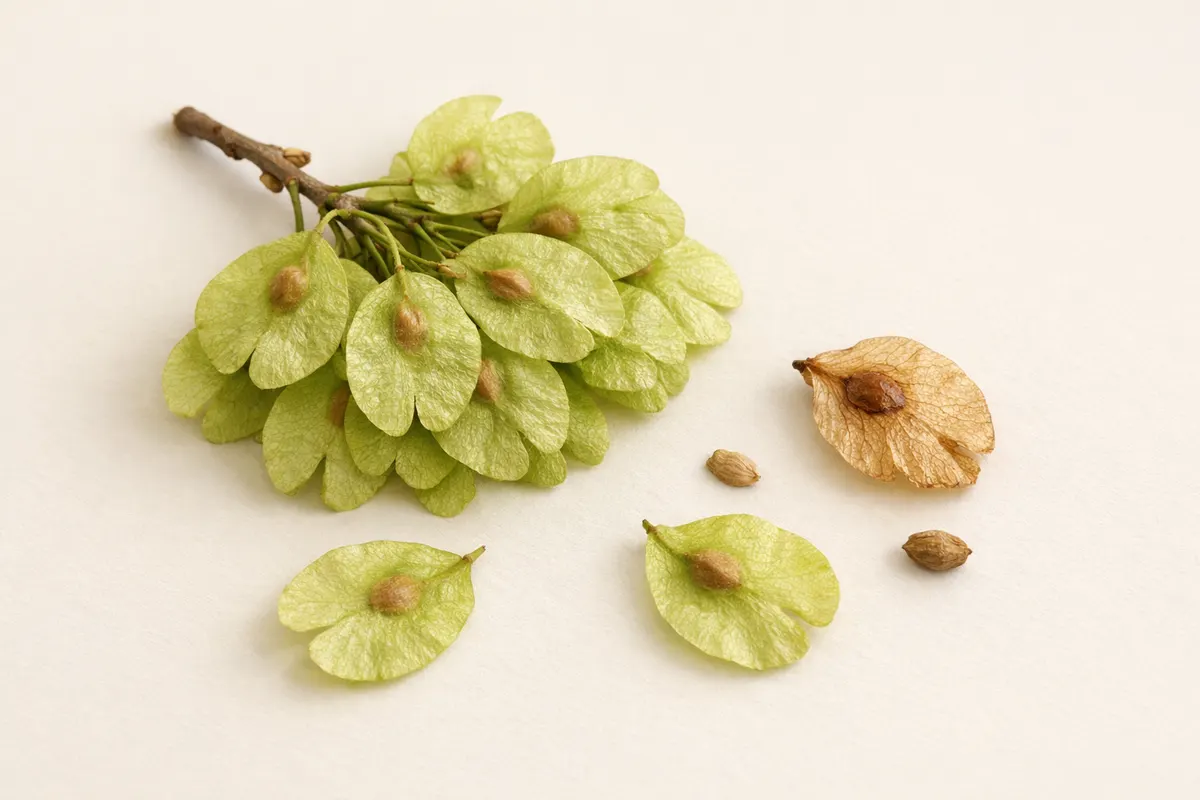
What elm tree seeds are and why they look like wings
Elm tree seeds are the flat, winged fruits produced by trees in the genus Ulmus, in the elm family Ulmaceae. They’re a type of samara: a thin, papery structure with a small seed centrally placed in the wing. When mature they often look like tiny round or slightly oval discs, each with a single seed near the center and radiating veins in the wing.
Fruiting time depends on the species and climate. American elm commonly sheds seeds in spring, while Chinese elm flowers in late summer and produces fruit later in the year. Do not reject an elm identification simply because a samara was found in autumn.
For gardeners and record keepers, elm tree seeds are most useful as a photo-identification subject: their wing shape, central seed placement, venation pattern, and how they attach to branch clusters are the clearest, repeatable clues you can capture without dissection.
- Typical family: Ulmaceae; common genera: Ulmus (elms).
- Size is species-dependent: measure the whole fruit and compare it with a species reference; Chinese elm samaras are about 1 cm long.
- Form: flat, papery wing with a single, roundish seed at or near the center.
- Timing varies: spring-fruiting and autumn-fruiting elms both occur.
- Why it matters: wing shape and central seed location are the quickest photo cues to separate elm samaras from other tree seeds.
How can you confirm elm samara identification from photos?
Start with the overall silhouette. An elm samara usually appears as a circular or broadly oval papery disk with a distinct seed body visible at the center. Photographs that include a scale (coin, ruler) make it easier to compare size against typical ranges and rule out much larger or much smaller lookalikes.
Zoom into the venation. Elm wings show fine veins radiating from the seed toward the wing margin; that radial venation and a thin, translucent wing are reliable photographic signals. Capture a sharp close-up of the wing and seed so the veins and the seed’s shape are clear.
Check attachment and grouping. Elm samaras are often borne in clusters along stems and can fall singly or in small bunches. If you can photograph the twig or branch where the seeds are attached, note whether they hang from short stalks and whether the leaves (if present) match elm leaf shapes — that contextual shot is as important as the close-up of the seed.
Use simple physical checks when you can handle a specimen. Elm seeds are thin and papery; they feel lightweight, the wing tears easily, and the seed at the center is small and usually round or slightly flattened. Avoid forcing any tests that damage the sample if you plan to keep it for verification or planting.
- Frame one photo for scale and one macro close-up of the seed center and veins.
- Note the season and the tree’s leaves or bark in a context photo to confirm genus-level ID.
- Avoid relying on color alone; sun exposure and age change wing tone quickly.
- If collecting, label date and location; check storage and sowing guidance for the identified species.
Key physical facts about elm tree seeds
This compact table summarizes the most repeatable, measurable attributes to check when you suspect a sample is an elm samara. Use these rows as a quick checklist when you examine your photos or a held specimen.
Note that values vary by species and region; treat the table entries as common ranges and distinguishing features rather than absolute rules.
| Attribute | Typical | Notes |
|---|---|---|
| Size | Varies by species | Measure the whole fruit; Chinese elm is an example at about 1 cm long |
| Wing shape | Circular to oval papery disk | Thin, translucent wing with visible veins |
| Seed position | Central or near-center | Round or slightly flattened kernel visible in the middle |
| Color when mature | Pale tan to light brown | Age and sun exposure darken the wing |
| Dispersal season | Spring or autumn, depending on species | Use local species information rather than a single calendar rule |
| Helpful combination | Wing outline, seed position, margin and tree context | No one feature independently confirms the species |
Where and when you’ll spot elm tree seeds
Elm samaras can be found wherever the relevant Ulmus species grows, including planted landscapes and natural stands. American elm is associated with bottomlands and other sites in eastern North America, but that habitat does not describe every elm. Identify the nearby tree rather than assigning a species from a seed’s location alone.
A clear field photo of the surrounding habitat can be as diagnostic as a seed close-up: elms are often planted as street or park trees and naturalize along riverbanks and in mixed hardwood stands. If you’re recording a find, note whether the area is a managed landscape or a wild stand, since planted cultivars and wild populations can differ in seed timing and abundance.
| Region or habitat | When you'll see it | What you'll notice |
|---|---|---|
| Urban streets and parks | Check the local species’ fruiting season | Clusters under trees; thin papery discs on pavement |
| Riparian and floodplain forests | Check the local species’ fruiting season | Samaras may accumulate along the ground or water margins |
| Hedgerows and old fields | Check the local species’ fruiting season | Scattered samaras among grasses and leaf litter |
| Nursery or planted rows | Check the local species’ fruiting season | Check the planting label and compare fruit from the same tree |
Seeds and samaras that are often mistaken for elms
Several other tree seeds can look superficially similar to elm samaras in a quick photo. The most common confusions are with maple samaras, ash samaras, and certain birch or alder droppings. The key is to compare wing shape, seed position, and venation.
Maple samaras are typically paired and have elongated wings. Ash samaras are generally longer and narrower than the rounded or oval fruits often associated with elms. A broken fruit can disguise these differences, so examine an intact example and the tree it came from. Loose fragments alone may not provide enough information.
- Maple (Acer): paired, elongated winglets (helicopter seeds) — look for two wings joined at one end.
- Ash (Fraxinus): single-winged but long and narrow — compare length-to-width ratio versus elm’s round wing.
- Check leaves and bark as supporting evidence: leaf teeth and asymmetry vary among elm species.
Care and handling for collected elm tree seeds
Keep collections labeled with the observation date, the parent tree if known, and the location. Protect the thin wings from crushing so their outline and edge remain available for identification. Photographs taken before handling can preserve details that are lost when a fruit breaks.
There is no universal elm-seed storage recipe. Species, seed maturity, moisture, and temperature all affect the appropriate method. Forest Research classifies wych elm seed as suitable for drying and controlled below-freezing storage, so a blanket instruction never to freeze elm seed would be misleading. That specialist guidance should not be generalized to an unidentified collection.
Before planting or storing a collection, identify the species and follow a relevant nursery or forestry reference. Some collections need pretreatment and others can germinate promptly. If germination matters, keep a record of the method and assess a small sample instead of assuming that the appearance of the wing establishes viability. For photo comparison alone, there is no need to promise a germination result.
Species references: USDA Forest Service, American elm — https://research.fs.usda.gov/feis/species-reviews/ulmame. Oregon State University, Chinese elm — https://landscapeplants.oregonstate.edu/plants/ulmus-parvifolia. Forest Research, wych elm seed storage — https://www.forestresearch.gov.uk/tools-and-resources/seed-storage/ulmus-glabra/.
- Keep the collection label and parent-tree photographs together.
- Treat identification and seed viability as separate questions.
- Use species-specific storage and pretreatment instructions.
- Before moving or planting collected material, check the requirements that apply to your location.
Frequently asked questions
Are round papery tree seeds likely to be elm samaras when I find them on my yard?
They can be, but several species produce round, papery seeds. Check for a small seed at the center of a translucent wing and for radial veins running out from that center. Context matters: note the nearby tree’s leaves and the season. If the seed is a single disk with a central kernel and you see elm-like leaves or a clustering under an elm, the odds increase but a photo-based ID is a best-effort, not a guarantee.
How long do elm tree seeds remain viable after I collect them?
There is no single shelf life for all elm seeds. The species and storage conditions matter, and a papery wing does not establish viability. Check an appropriate species reference before storing or sowing. Forest Research, for example, gives controlled cold-storage guidance for wych elm that should not be treated as a recipe for every elm.
What photo details are most useful for elm samara identification?
Prioritize three images: one close-up of the seed center and wing veins, one shot that includes a scale (coin or ruler), and one context photo showing the tree’s leaves or bark. Those three perspectives together let you compare wing shape, venation, size, and tree context — the combination is far more diagnostic than any single picture.
Can Seed Identifier - Seedio help confirm an elm samara identification from my phone photo?
Seed Identifier - Seedio can be a helpful additional comparison after you’ve photographed the key features (seed center, wing veins, and a contextual leaf/bark shot). Use the app as a first-pass match alongside the visual checks on this page; remember that a single photo rarely guarantees species-level certainty, so treat app feedback as one piece of evidence and consider local expert verification for important uses.
Related guides
Compare your photos with Seed Identifier - Seedio as a next check
Use Seedio for an app-assisted comparison of your photographs, then check the suggested identification against the tree and a species reference. For another starting point, visit https://seedidentification.app/identify/what-seed-is-this. For general photo and seed-checking guidance, see https://seedidentification.app/blog/plant-seed-identification.
Take the next step →