

Tree Seed Pod Identification Pictures: Photo Guide & Clues
Use photo clues and a simple workflow to evaluate tree seed pod identification pictures, with common lookalikes, photo tips, and safe next steps.
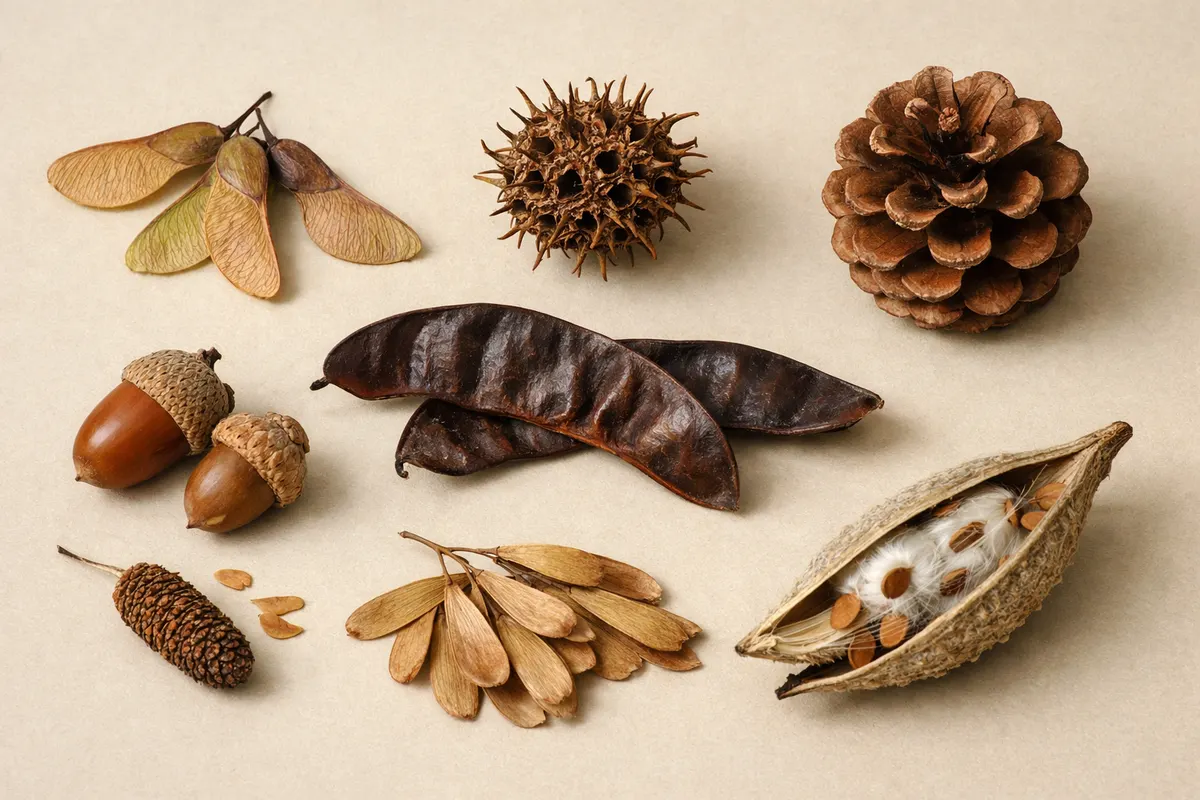
Quick answer: identify tree seed pods from photos
Tree seed pod identification pictures can give a fast, practical ID when the photo shows the pod’s overall shape, attachment point, and surrounding context. Key visual clues—whether the pod is winged (samaras), split open (legume-like), woody (nut or cone), or papery (capsules)—often narrow candidates to a genus or small group of species.
A single clear photo can often tell you whether you’re looking at a maple samara, locust-like legume, beech/mast nut, or a seed capsule from a poppy-like flower, but it rarely proves viability or exact species. Treat the photo as a first pass: use visible features to shortlist possibilities, then verify with additional photos, habitat notes, or seed anatomy checks.
If you want a quick next step after checking the photo clues below, try a visual-identification tool such as the Seed Identifier - Seedio seed pod tool at https://seedidentification.app/tools/seed-pod-identifier as one optional first-pass check alongside manual verification.
What tree seed pod identification pictures show and what they don’t
A photo of a seed pod records external form: size, shape, symmetry, surface texture, color, and how the pod attaches to the branch. Those external traits are the primary data people use to assign a visual match. For example, a pair of winged samaras joined at the seed strongly suggests a maple (Acer), while an elongated pod that splits along two seams points toward legumes (Fabaceae) such as locusts or honeylocust.
Photos also capture contextual signals that help identification: the tree’s bark texture, nearby leaves (if present), the arrangement of pods on the twig (clusters versus single), and the substrate beneath the tree (litter, cone scales, or fallen winged seeds). These contextual clues often separate lookalikes that share a similar pod shape but differ in leaf type or growth form.
What photos do not prove: internal seed anatomy, germination potential, or exact species in many genera. Two species can produce near-identical pods but differ in seed coat hardness or embryo maturity—traits you cannot see from an external picture. Treat a photo-led ID as a probabilistic conclusion and plan a verification step (seed dissection, multiple-season observation, or lab testing) if you need certainty.
Key clues
When evaluating tree seed pod identification pictures, prioritize the clues that most reliably separate major groups. Below are the strong, medium, and supporting clues to look for in the image and its surrounding context.
Before listing clues, make sure the photo shows a scale reference (coin, ruler, or finger) and a clear view of how the pod attaches to the branch. Without those, many identifications remain ambiguous.
- Strong clues (high confidence): overall pod type (winged samara, two-seamed legume, woody nut or cone, papery capsule), attachment (single, paired, cluster), and pod symmetry (bilateral vs. radial).
- Surface details: wing veins, ridges, hairs, or spines—maple samaras show a central seed with a single wing; ash keys are compound and paired differently; hornbeam and beech nuts have distinct husks.
- Attachment and arrangement: paired samaras (maple), long chains of pods (some legumes), clusters of woody cups (oaks and beeches produce nuts in cups), and dangling catkin-like clusters (birch, alder) all point to different families.
- Leaf and bud context: even a partial leaf shape or bud pattern in the photo can reduce species possibilities dramatically—compound leaves suggest legumes, opposite leaves often indicate maples or ashes.
- Size and scale: small (a few millimeters) versus large (several centimeters) is diagnostic. A 1 cm samara behaves differently taxonomically than a 6 cm papery pod.
- Seasonality and condition: fresh green pods, mature brown pods, and opened shells indicate different life stages; opened pods often mean mature seeds have dispersed and only empty husks remain.
- Medium clues (moderate confidence): color and sheen, presence of remaining seeds inside, and whether the pod remains on the tree after leaf drop (evergreen cones vs. deciduous capsules).
- Supporting context (useful but low confidence alone): nearby habitat (wetland, roadside, forest edge), presence of other reproductive structures (flowers, catkins), and evidence of animal feeding or caching which can alter pod appearance.
- Photo quality checklist: include a close-up with correct focus, a shot showing attachment, one image with a scale reference, and a wide shot showing the whole tree or branch habit for context.
Step-by-step workflow
Use this simple workflow to turn a single photo into a reasoned identification. The process emphasizes observable traits first, then uses context and targeted verification to reduce uncertainty.
Work through the steps in order: capture high-value images, classify the pod type, compare to known groups, check for lookalikes, and schedule follow-up checks if you need a species-level ID or viability information.
- 1) Capture or select the best photos: choose a sharp macro of the pod, a clear image of the attachment point, a scale reference, and a habitat/branch shot. Multiple angles reduce guesswork.
- 2) Describe the pod in short phrases: winged or not, single or paired, smooth or spiny, woody or papery, opened or closed. Write down measurements if possible.
- 3) Sort into major categories: samara/winged, legume/pod, nut/cone, capsule/seed head. Use these categories to limit candidate families (Acer = samara, Fabaceae = legume, Fagaceae = nuts/cones).
- 4) Check leaf and bud clues: if leaves are present, note arrangement (opposite vs. alternate), leaflet presence, and leaf margin—these often eliminate lookalikes quickly.
- 5) Compare to reference images: use field guides or targeted pages like the Tree Seed Pod Identification by Photo post for visual matches and genus-level comparisons.
- 6) Eliminate common lookalikes: consider seasonal stage (immature pods versus dried husks) and damage from insects or animals which can mimic other species’ pod appearances.
- 7) Choose an ID confidence level: high (multiple matching traits and context), medium (key traits match but missing leaves or scale), or low (only one trait visible).
- 8) Decide next steps based on confidence: if high confidence, note seed-handling advice; if medium or low, gather more photos, collect a sample for close inspection, or use a rapid visual-identification tool such as the Seed Identifier - Seedio seed pod tool at https://seedidentification.app/tools/seed-pod-identifier for a first-pass suggestion.
- 9) If propagation or safety matters, perform verification: dissect the pod to inspect the seed coat, test floatation and viability only after confirming species-level ID through multiple lines of evidence.
Examples
Example 1 — Paired winged seeds: A pair of flat, paired wings joined at a central seed is a classic maple samara. If the photo shows opposite leaves nearby and a 2–3 cm wing, the ID can be high confidence for genus Acer. Maple samaras differ by wing angle and seed position, so compare front and side views.
Example 2 — Long, slender pods on a branch: Pods hanging singly or in chains that split along two seams and leave a papery husk typically indicate a legume (Fabaceae). Look for pinnate leaves in the wider shot—this context will often confirm the family even if the pod lacks distinctive markings.
Example 3 — Woody cupules and nuts: Rounded nuts inside a scaly or bristly cup point toward oaks, beeches, or hornbeams. The cupule texture and whether the nut is smooth or ridged are distinguishing features. If the photo includes fallen nuts beneath the tree, count them and note whether they were partially eaten by rodents.
Example 4 — Papery capsules and seed clusters: Species that release many tiny seeds (poppy-like capsules, willowherb seedheads, or poplar capsules) often leave a papery husk or a fluff of hairs. A wide-shot showing the tree’s habit helps separate small-seeded shrubs from true trees.
- Practical tip: when you can’t get leaves, use bark texture and branching angle as secondary clues—smooth gray bark with horizontal lenticels in a photo suggests different genera than deeply furrowed, thick bark.
- Use internal links where helpful: for a broader visual comparison across pod types, see Tree Seed Pod Identification by Photo: Pods, Samaras, Nuts, and Cones.
- Regional note: some genera are common in specific regions; if your photo is from a known bioregion, filter candidate species accordingly.
Limitations
Photos are a powerful first step, but they have practical limits. Species within the same genus may produce nearly identical pods, and environmental factors (sun-bleaching, insect damage, partial decomposition) can obscure diagnostic traits. Do not treat a single image as definitive for species-level identification or for determining seed viability.
If the goal is propagation, viability testing or professional verification is necessary. A picture cannot show embryo health, internal mold, or whether dormancy mechanisms exist—factors that determine whether a seed will germinate. For germination guidance and seed-handling best practices, follow established protocols rather than assuming viability from appearance.
When safety or legal concerns exist (for example potential toxicity, protected species, or regulated seeds), escalate to an authoritative source. Photos can help triage, but contact a local extension service, botanist, or certified seed lab for verification before collecting or distributing seeds.
- High-confidence outcome: clear pod type plus supporting leaf/bark context and scale reference—likely genus-level ID.
- Partial outcome: clear pod type but missing leaves or attachment—family-level or group identification only.
- Low-confidence outcome: single poor-quality photo without scale or context—avoid using this as the sole basis for propagation or safety decisions.
- When to verify: species-level certainty, seed trade or sale, legal protection, or any use where misidentification has consequences.
Related guides
Need a fast visual check of your seed pod photo?
After you’ve checked the key photo clues above, use the Seed Identifier - Seedio seed pod tool as an optional first-pass to narrow possibilities quickly: https://seedidentification.app/tools/seed-pod-identifier. Treat tool suggestions as an aid, then verify with extra photos or a local expert before collecting or starting propagation.
Take the next step →Frequently asked questions
How many photos do I need for a reliable seed pod ID?
Aim for at least three photos: a close-up of the pod, a shot of the attachment point or cluster on the branch, and a wider image showing leaves or the tree habit. Include a scale reference like a coin or ruler. Multiple angles and contextual shots move an ID from guesswork to a reasoned match.
Can a photo tell me if a seed inside a pod will germinate?
No. External photos show maturity and physical appearance but not viability. Viability depends on internal embryo health, moisture history, and dormancy mechanisms—factors you must test with germination trials, tetrazolium testing, or lab analysis to be sure.
What common lookalikes should I watch for in seed pod photos?
Frequent confusions include samaras from ash versus maple (leaf arrangement separates them), legume pods versus elongated capsules (seed arrangement differs), and small woody nuts versus insect-galled pods. Always cross-check with leaves, bark, and pod attachment before finalizing an ID.
What should I do after I identify a seed pod from a photo?
If identification is for curiosity, record the ID and note where you photographed it. If you plan to collect seeds, follow legal and ethical guidelines, check local regulations, and perform seed-handling steps: collect mature seeds, clean and dry them properly, and run a viability test before storage or planting. For a fast, additional visual check, consider a first-pass with the Seed Identifier - Seedio seed pod tool at https://seedidentification.app/tools/seed-pod-identifier, then verify by physical inspection or expert consultation if needed.