

Seed Identification
Chestnut: Identification, Habitat, and Real Examples
Learn which chestnut identification details a photo can prove, which it cannot, and the follow-up checks worth doing before you rely on the answer.
What a chestnut is and which group it belongs to
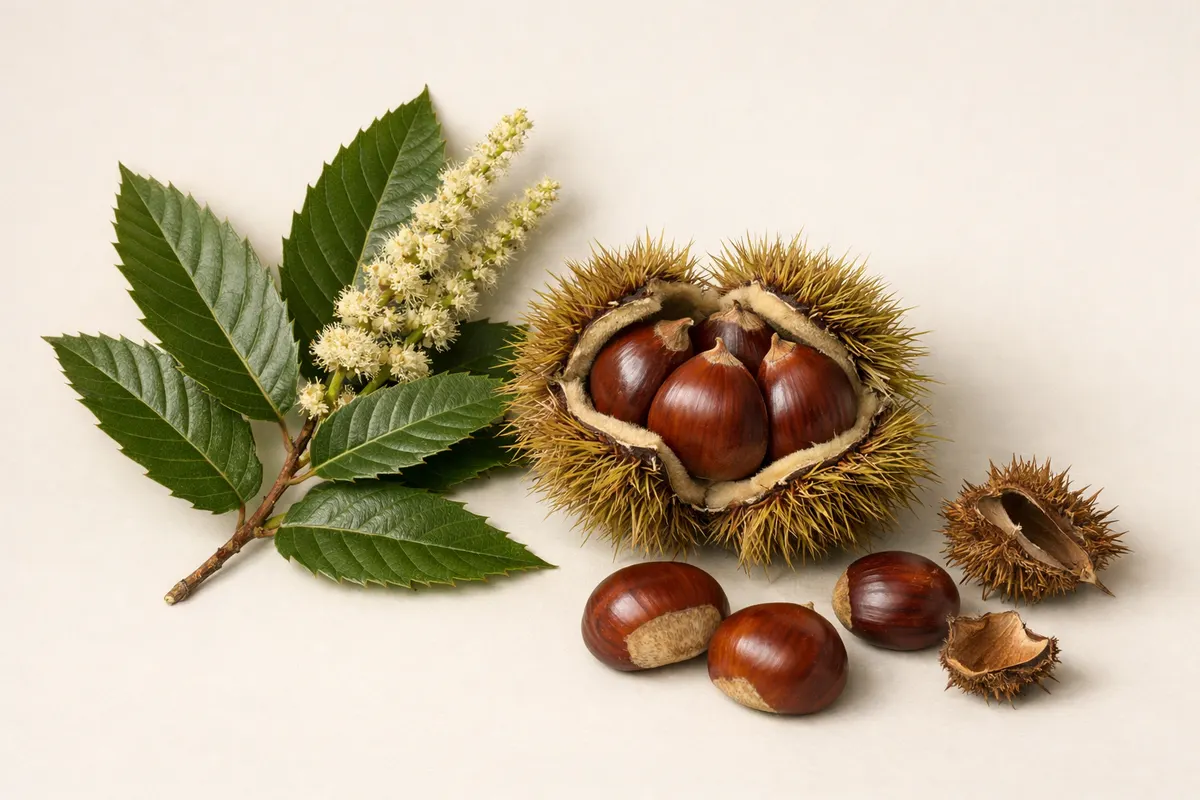
Chestnut refers to trees and shrubs in the genus Castanea (most commonly Castanea sativa in Europe and Castanea dentata historically in eastern North America). The word describes the whole plant, its spiny husks (burs), and the glossy brown nuts inside. Chestnuts are members of the beech family (Fagaceae) and are known for their edible nuts and distinctive spiny seedcases.
A mature chestnut tree can range from a medium-sized shrub to a large tree 10–30 m tall depending on species, site, and age. Leaves are simple, alternate, and typically 10–25 cm long with sharp, often regularly spaced teeth. The nuts themselves are roughly spherical to slightly flattened and have a lustrous mahogany to chestnut-brown shell with a pale patch where they were attached inside the bur.
Chestnut identification balances multiple visible clues: leaf shape and teeth, the spiny outer husk, the glossy nut shell, and the tree’s growth habit. Photographs that include a nut, an open or closed bur, and a few leaves give the strongest evidence for identification; isolated shells or seeds are less conclusive without context.
How can you identify a chestnut from photos?
Start with the bur: chestnut burs are densely covered with long, sharp spines and split into four or more segments when mature, revealing one to three glossy nuts. In contrast, many lookalike species have smooth or sparsely spined capsules. A clear close-up of the intact bur or a split bur is one of the most diagnostic photo clues.
Next, check the nut: true chestnuts have a flat side with a pale, rough scar (hilum) and a shiny, deep brown shell. The shell tends to be relatively thin compared with some non-edible lookalikes. Photograph the nut from multiple angles so the hilum and overall shape are visible—this helps separate chestnuts from horse chestnuts and buckeyes.
Leaf detail matters: chestnut leaves are long, lanceolate, and sharply toothed with parallel veins ending at each tooth. If your photo includes leaves, crop or zoom to show several teeth and the vein pattern. Bark texture and the presence of long catkin flowers in spring (if visible) are additional checks to support an identification.
Don’t rely on a single clue. A nut-like seed on the ground could be a beech mast, a horse chestnut (conker), or a seed from another tree. Use multiple independent photo-evidence points—bur, nut, leaf, and nearby fruiting structures—before concluding chestnut identification. If you want an additional, optional check, Seed Identifier - Seedio can compare your photo against these specific clues, but treat that as a first-pass aid rather than definitive proof.
- Bur: densely spined, splits open into sections—look for 1–3 nuts inside.
- Nut: glossy mahogany brown with a pale attachment scar on one side.
- Leaf: long, toothed margins with veins reaching each tooth.
- Flowers/fruiting: long catkins in spring; burs mature in autumn.
Key chestnut facts at a glance
This compact table lists the attributes most useful for chestnut identification in photos. Each row highlights a stable feature you can verify with a clear image and a short note about what to expect.
Use images that include scale (a ruler or coin), a close-up of the bur or nut, and, where possible, a leaf or twig to make the table entries verifiable from photos.
| Attribute | Typical chestnut | Notes for photos |
|---|---|---|
| Tree size & habit | Medium to large tree (10–30 m) or multi-stem shrub | Show trunk or branching pattern if possible |
| Leaves | 10–25 cm, lanceolate, sharply toothed | Zoom to teeth and vein ends at each tooth |
| Bur (husk) | Round, covered in long sharp spines; splits into sections | Close-up of intact or split bur is diagnostic |
| Nut (seed) | Glossy mahogany-brown with pale attachment patch | Photograph hilum and profile of the nut |
| Season | Burs and nuts visible late summer to autumn | Flowers (catkins) appear in spring |
Where and when you’re most likely to find chestnuts
Chestnuts are most conspicuous when burs drop in late summer and autumn. The table below summarizes typical habitats and the seasonal window when you’re likely to notice burs, nuts, or flowers in photographs.
Local abundance depends on species and land use: cultivated sweet chestnut (Castanea sativa) will be common in managed woodlands, orchards, and hedgerows in suitable climates, while remnant or planted native trees may be scattered along older forest margins and parks.
| Region / habitat | When you'll see it | What you'll notice |
|---|---|---|
| Temperate woodlands (Europe, cultivated) | Late summer to autumn | Clusters of spiny burs on ground, glossy nuts |
| Parks, avenues, and older orchards | Late summer to autumn; spring flowers | Single trees with many burs; long catkins in spring |
| Forest margins and hedgerows | Autumn for burs; spring for catkins | Scattered burs, leaf litter with nuts |
| Introduced stands (North America, Asia) | Autumn for nuts; depends on local planting | Nuts under trees; sometimes confused with planted horse chestnuts |
Sweet chestnut vs horse chestnut: how to tell them apart
The most frequent confusion comes from horse chestnut (Aesculus hippocastanum), commonly called a conker, and true chestnuts (Castanea species). Horse chestnut capsules are typically smooth or with short, blunt spines and open to reveal a single glossy seed with a large pale eye; the seed is more spherical and harder-shelled looking than a sweet chestnut.
A quick photo check: if the outer capsule has long, needle-like spines and splits into sections holding two to three flat-sided nuts, you likely have a Castanea chestnut. If the capsule is comparatively smooth and the seed looks like a single round conker with a rounded scar, you likely have a horse chestnut.
Other lookalikes include beech nuts (smooth triangular seeds inside prickly coverings that are less spiny than chestnut burs) and some buckeye species. Photographic clues—bur detail, seed scar shape, and leaf morphology—are the reliable differences. If the visual evidence is ambiguous, capture a close-up of the capsule and the leaf margin.
For other visually similar tree fruits with distinctive structures, see the Osage Orange page for comparison of round, woody fruiting bodies and Elm Tree Seeds for differences in samara-type seeds when seeds and burs are not present. These linked pages can help when the fruiting structure in your photo doesn’t match a chestnut’s bur.
- Horse chestnut (Aesculus): smooth or lightly spined capsule, single round conker, palmate leaves.
- True chestnut (Castanea): heavily spined bur, 1–3 flattened chestnuts, serrated leaves with parallel veins.
- Beech: small triangular nuts in thinly spined husks; nuts smaller and sharply three-sided.
Care, handling, and safety around chestnuts
If you plan to collect chestnuts for eating, handle them with caution: only harvest from trees you have confidently identified as edible Castanea species. Raw horse chestnuts and some lookalikes contain compounds that can cause digestive upset and are not edible like sweet chestnuts.
Freshly fallen burs are sharp—use gloves to open them. Once removed, dry shelled chestnuts for short-term storage and cook them before eating; cooking both improves texture and reduces mildly astringent compounds present in some varieties.
Follow local regulations: in some regions wild collection is restricted in protected woodlands or private grounds. When in doubt about edibility or legal permissions, leave specimens in place and seek local expert confirmation.
Frequently asked questions
How can I do edible chestnut identification safely when I find fallen nuts?
To assess edibility from photos, confirm the nut comes from a Castanea bur (densely spined and splitting into sections) and shows the typical flat side and pale attachment scar of a sweet chestnut. Check leaf photos for long, sharply toothed margins with veins ending at each tooth. Even with good photos, do not assume edibility without local confirmation; when you plan to taste a wild nut, cook a small sample and consult a local botanical authority if you’re unsure.
Can I tell chestnut species from a single photo of a nut on the ground?
A single nut photo can suggest chestnut if it clearly shows the glossy brown shell and pale hilum, but it often isn’t sufficient to determine species. Species-level ID usually requires leaves, burs, or flowering structures. Treat a single photo as provisional and try to add images of the bur, leaf margin, and an overall tree shot for a more reliable identification.
Are chestnuts safe for my dog or other pets?
Sweet chestnuts (Castanea) are not commonly toxic to dogs in small amounts, but any large ingestion of nuts can cause digestive upset, and horse chestnuts (Aesculus) contain toxic compounds that can be harmful. Because lookalikes are common, keep pets from eating unknown nuts and consult a veterinarian immediately if you suspect ingestion of a potentially toxic seed.
What should I photograph to make chestnut identification easier?
Photograph an intact bur, a split bur showing the nuts, close-ups of the nut’s pale attachment scar, several leaves showing teeth and veins, and a wider shot of the tree or branch. Include a scale object like a coin. Multiple, well-lit angles reduce ambiguity and let tools or local experts check key features without needing to handle the specimen.
Related guides
Compare your photo to these chestnut clues
After you check the bur, nut, and leaf details, use Seed Identifier - Seedio to compare your photo against the chestnut clues listed here as a quick, optional next step. Treat the app as a first-pass matchmaker—confirm any identification with additional photos or a local expert, and never rely on one image alone for edibility or safety decisions. Learn more and try a photo comparison at https://seedidentification.app/.
Take the next step →